Supreme Audit Institutions Performance Measurement Framework (SAI PMF)
SECTIONS
INDEPENDENT REVIEW

IDI provides several forms of support to help SAIs conduct SAI PMF assessments, from training and facilitation programmes to targeted advice. The independent review function complements these by ensuring quality, high-standard outputs.
Our independent reviewers are experienced SAI PMF experts who check that each assessment follows the SAI PMF methodology and that findings are based on sound evidence. This service is free of charge and fully confidential.
Our reviewers:
Each review concludes with an Independent Review Statement, which can be included in the final SAI PMF report.
Our reviewers will verify that:
Terms of Reference should describe how quality will be ensured. We recommend a two-level approach before the independent review:
Level 1: Internal Quality Control
Conducted by the assessment team leader to verify the accuracy and consistency of the work.
Level 2: External Quality Control
Performed by SAI managers, staff, or donor partners who were not part of the assessment team but know the SAI context well.
They check that facts are correct and interpretations sound before submission for independent review.
Having the right skills in place will enable a high-quality assessment that will contribute to the capacity development and further strengthening of your SAI. The main target group are SAI PMF assessors, but the course can also be relevant for others that want to enhance their SAI PMF skills.
The estimated time to complete the course is 2-3 days. A certificate can be provided upon completion. To request a certificate please send an e-mail to saipmf@idi.no once you have finalised the entire course
See below a key message from the Director General of IDI, our repeat assessment video, description of prerequisites necessary for taking the course and link to access the course through LMS.
“The importance of a SAI PMF repeat assessment can not be overemphasized. As the operation lead on the global roll-out and implementation of SAI PMF, the IDI encourages more SAIs to conduct a repeat assessment as a means to monitor progress in performance”.
– Mr Einar Gørrissen, Director General of IDI
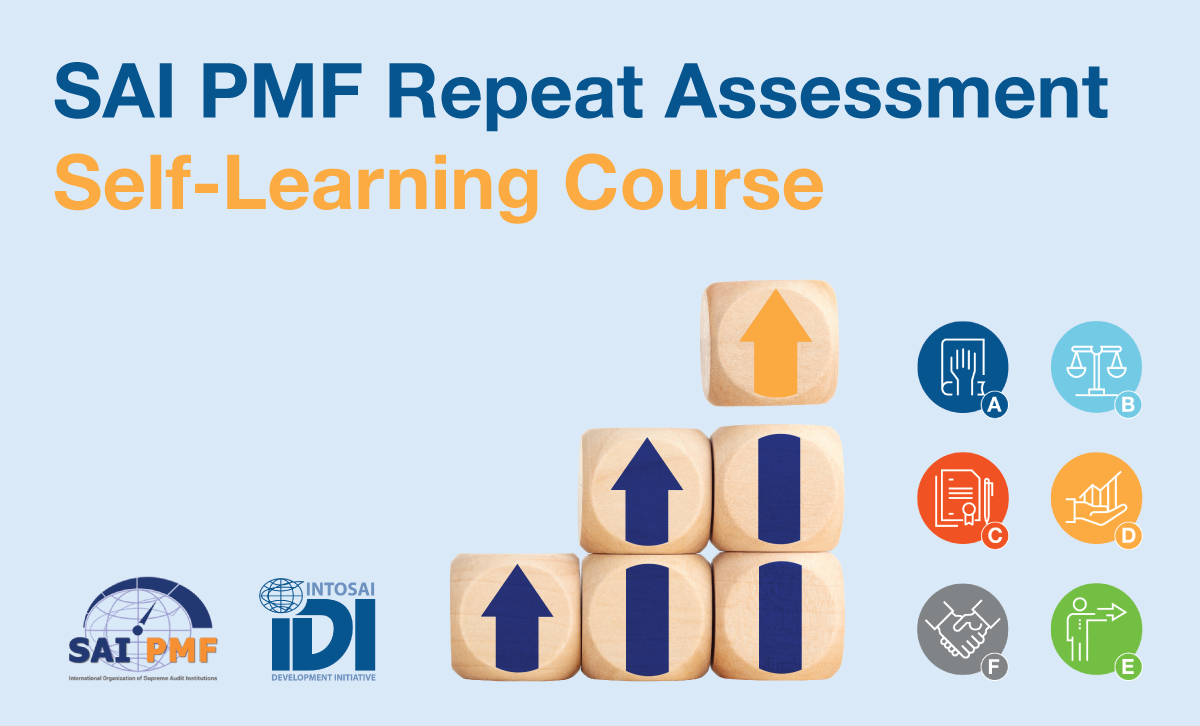
It is an assessment of a SAI which has previously assessed its performance using the SAI PMF. A repeat assessment is particularly useful when a SAI wants to monitor its progress in performance over time, for instance, its strategic plan period.
It is open to all interested individuals and can be taken at any time convenient to the learner. This course is designated to be taken by anyone planning to conduct a repeat assessment, whether SAI staff, consultants or others. If you are currently not planning to conduct a repeat assessment, it can still be helpful to take the course to enhance your SAI PMF expertise and acquire a better understanding of the specificities of a repeat assessment.
It is important to note that this course is intended to cover only part of the SAI PMF methodology related to key aspects of a repeat assessment. It is a prerequisite that you have previous SAI PMF knowledge and already have a good understanding of the following subject areas:
The self-learning course is now available on IDI LMS platform: https://lms.idielearning.org/course/view.php?id=493
Information on how to access the course can be found here
The 2025 Revision of the SAI Performance Measurement Framework (SAI PMF), endorsed at INCOSAI, builds on the 2016 and 2022 versions to make the tool modern, accessible, and user-friendly. Reflecting evolving ISSAIs and global best practices, the new SAI PMF offers a relevant and credible framework for assessing SAI performance. It introduces e-SAI PMF, a digital platform for efficient, high-quality assessments, and enhanced guidance materials supporting both new and repeat users to ensure lasting impact and transparency.
There are two previous versions of the SAI PMF: 2016 and 2022. There is a high level of comparability between the 2016 and 2022 versions. The content of what you assess is the same with the exception of the indicators for SAIs with a jurisdictional function. The key changes reflected compared to the 2016 version are:
-References are aligned to IFPP
-Reformulation of some criteria under indicators SAI-9 and SAI-10 to reflect changes in ISSAI 200. The content of what you assess, the number of criteria and the rule for aggregating dimension score is still the same.
-More substantial revision to the indicators for SAIs with a jurisdiction function (SAI 8 (iv), SAI 18-20).
Available in several languages, you can access the 2022 and 2016 SAI PMF below:

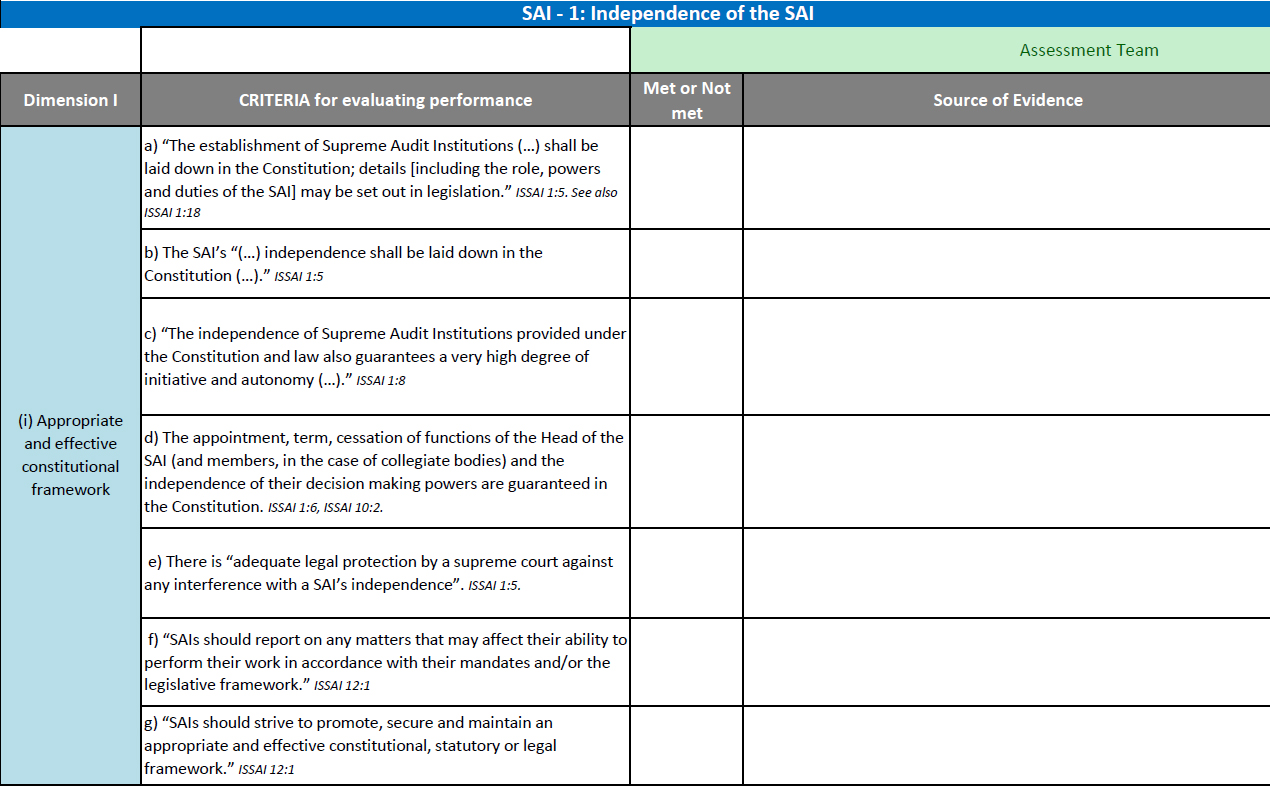
Worksheets including all indicators, dimensions and criteria which assists assessors in documenting the assessment and scoring of the individual criteria. The English, Spanish and French versions are aligned to the 2022 SAI PMF version. The Arabic worksheets are under update
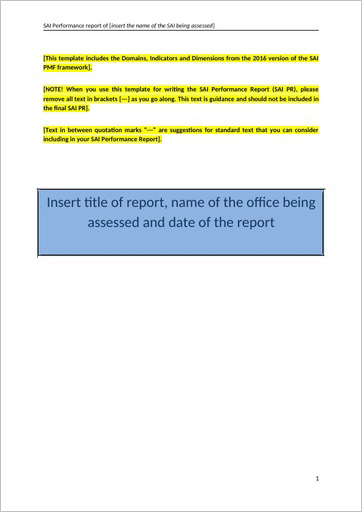
Templates for writing the SAI PMF performance report. These include all sections and tables that should be in the report and guidance on how to write the sections is provided within the template. Note that the SAI PMF dimensions now has a numerical value. For example, Dimension (1) instead of Dimension (i). This will over time be changed in all SAI PMF documents. Note that unfortunately the Arabic version is not the newest version. The Arabic version you can access here is still very usable and will greatly support you. We hope to upload the new version soon
Provides a list of documents that may be relevant to review when conducting an assessment.

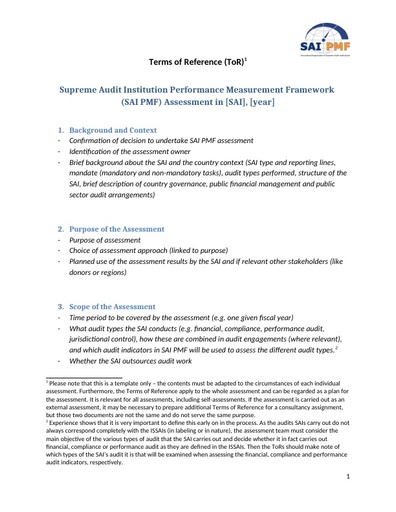
The template includes all sections and tables that should be included in the ToR and guidance is provided within the template.
The guidance provides advice to assessment teams on how to conduct a repeat SAI PMF assessment and how to compare the results of two assessments to understand how performance has changed.
The worksheets can be used to register the assessment results and analyse performance change in a simple and practical manner. Worksheet 1 should be used when the pilot version was used for the first assessment and the 2016 version was used for the repeat assessment. Worksheet 2 should be used when the 2016 version was used for both assessments.
Template for writing the SAI PMF performance report for a repeat assessment. The template includes all sections and tables that should be in the report. The template includes additional tables and guidance on how to report on performance change. Note that the dimensions now has a numerical value. For example, Dimension (1) instead of Dimension (i). This will over time be changed in all SAI PMF documents
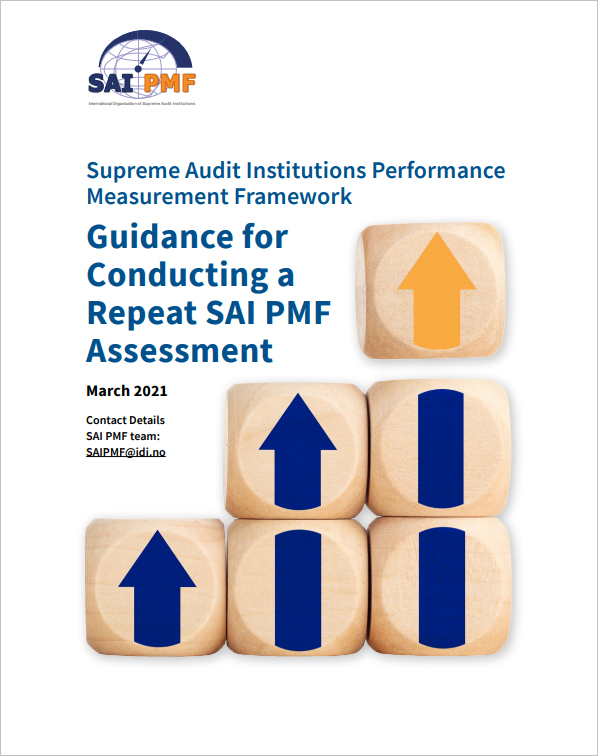
The guidance is aimed at SAIs that consider using SAI PMF for additional monitoring such as annual monitoring or assessment of only certain features of SAI performance. The guide provides SAIs with specific advice on how to use SAI PMF for this purpose while preserving the integrity of the tool. The guidance is paired with an excel-sheet that provides an overview of areas in SAI PMF suitable for this purpose and the evidence base.
It is important to note that this does not replace a holistic assessment and you can find guidance on repeat assessments in the section “SAI PMF Repeat Assessment Toolkit”.
A collection of questions which are asked frequently by SAI PMF assessors in the course of conducting a SAI PMF, along with responses from the SAI PMF team at IDI.

The SAI PMF serves as an excellent communication tool and there are many benefits from publishing and sharing SAI PMF results. In this roadmap we are outlining some options on how this can be done.
The following SAI PMF reports are published and publically available.
Country | Year | Version | Language | Assessment details | Download |
Albania | 2022 | 2022-2016 version | English | ||
Aruba | 2021 | 2016 version | English | ||
Bhutan | 2015 | Pilot version | English | ||
Bhutan | 2021 | 2016 version | English | Repeat assessment | |
Chuuk (Federated States of Micronesia) | 2021 | 2016 version | English | ||
Colombia | 2019 | 2016 version | Spanish | ||
Costa Rica | 2014 | Pilot version | Spanish | ||
Georgia | 2022 | 2016 version | English | ||
Guam | 2017 | 2016 version | English | ||
Guatemala | 2020 | 2016 version | Spanish | ||
Jamaica | 2017 | 2016 version | English | ||
Cyprus | 2017 | Pilot version | English | ||
New Zealand | 2016 | 3.2 version | English | ||
Fiji | 2020 | 2016 version | English | ||
Palestine | 2016 | Pilot version | English | ||
Nepal | 2015 | Pilot version | English | ||
New Zealand (summary) | 2016 | 3.2 version | English | ||
Norway | 2017 | 2016 version | Norwegian | ||
Costa Rica | 2019 | 2016 version | Spanish | Repeat assessment | |
Sri Lanka | 2018 | 2016 version | English | ||
Peru | 2016 | Pilot version | Spanish |
We are very excited to announce that you can now start use the application for your SAI PMF assessment!
e-SAI PMF is an online application that will support SAIs and SAI PMF assessors to conduct rapid, high-quality, and efficient assessments through all the key stages of an assessment process. E-SAI PMF is currently available in English, Spanish and French.
Please contact the IDI SAI PMF team at saipmf@idi.no to get access to the application and with any questions you may have.





You can reach the SAI PMF team by e-mailing saipmf@idi.no.
SAI PMF measures how effectively a SAI operates against the International Standards of Supreme Audit Institutions (ISSAIs) and other recognised good practices. It looks at both audit and non-audit functions, giving a complete view of the institution’s systems, standards, people, and results.
What it measures:


A repeat assessment strengthens accountability, supports continuous learning, and reinforces the SAI’s role as a model of transparency. Repeat assessments give SAIs the chance to:


We’re always keen to connect with SAIs, partners, and experts who share our commitment to strong, credible, and accountable oversight institutions.
Reach out to our team to learn more, collaborate, or exchange experiences on strengthening performance and institutional capacity through the SAI PMF framework at saipmf@idi.no
SAI PMF (Supreme Audit Institutions Performance Measurement Framework) is a globally recognised tool that gives SAIs that evidence. It takes a whole-of-institution view — systems, people, and results — to support better planning, stronger performance, and greater accountability.
By using SAI PMF, oversight institutions can set a clear baseline, share a common language for improvement, and publish results that build trust with citizens and partners.

SAI PMF gives you a full, evidence-based view of how your institution performs across all key areas, from independence and ethics to audit quality, resources, and stakeholder engagement. By identifying what works well and where there’s room to grow, your SAI can focus improvement efforts where they matter most.
Your first SAI PMF assessment establishes a clear baseline of performance. Repeat assessments every 3–5 years let you measure progress and see how reforms or new strategies are making an impact. This cycle of learning and improvement supports stronger, more sustainable institutions.
SAI PMF results are a strong foundation for planning. Many SAIs use their assessment to shape strategic priorities, strengthen internal processes, and design capacity development projects. The framework links evidence directly to action, ensuring plans are realistic, measurable, and aligned with your mandate.
Publishing or sharing your SAI PMF report shows transparency and commitment to improvement. It helps demonstrate your institution’s value to citizens, parliament, and partners, and builds trust by showing clear, verifiable results. Quality-assured assessments reviewed through IDI’s independent process also strengthen credibility across the global SAI community.
The e-SAI PMF platform streamlines the process, from planning and evidence gathering to scoring and reporting. Using this modernised tool saves your institution time, supports collaboration, and helps ensure consistency and quality in your assessment.
The INTOSAI Capacity Building Committee (CBC) provides the strategic lead for SAI PMF implementation. Established to strengthen the institutional and professional capacities of Supreme Audit Institutions (SAIs), the CBC oversees the SAI PMF Strategy on behalf of INTOSAI, ensuring alignment and coordination across the INTOSAI community and with other CBC work streams.
In close collaboration with IDI, the CBC plays a vital role in maintaining the relevance and quality of the SAI PMF and ensuring that SAIs and their stakeholders continue to benefit from this important framework for performance measurement and improvement.









We’re always keen to connect with SAIs, partners, and experts who share our commitment to strong, credible, and accountable oversight institutions.
Reach out to our team to learn more, collaborate, or exchange experiences on strengthening performance and institutional capacity through the SAI PMF framework at saipmf@idi.no