



Audit Tech & AI

The AI & Tech in Audit Challenge 2026–2027
At its core is a global sandbox where multidisciplinary teams collaborate to develop and test innovative prototypes across key audit areas. The initiative provides a safe space for learning, experimentation, mentorship, and collaboration, with a strong focus on inclusion, ethics, and real-world application in diverse SAI contexts.
Building on IDI’s commitment to innovation and digital transformation, the Challenge responds to the growing need for SAIs—particularly in developing contexts—to explore, adapt, and implement emerging technologies. It recognises that successful innovation requires partnerships, diverse expertise, and opportunities to learn by doing.
The initiative also includes awards for winning solutions and support for implementing selected innovations in participating SAIs.
How does it work?
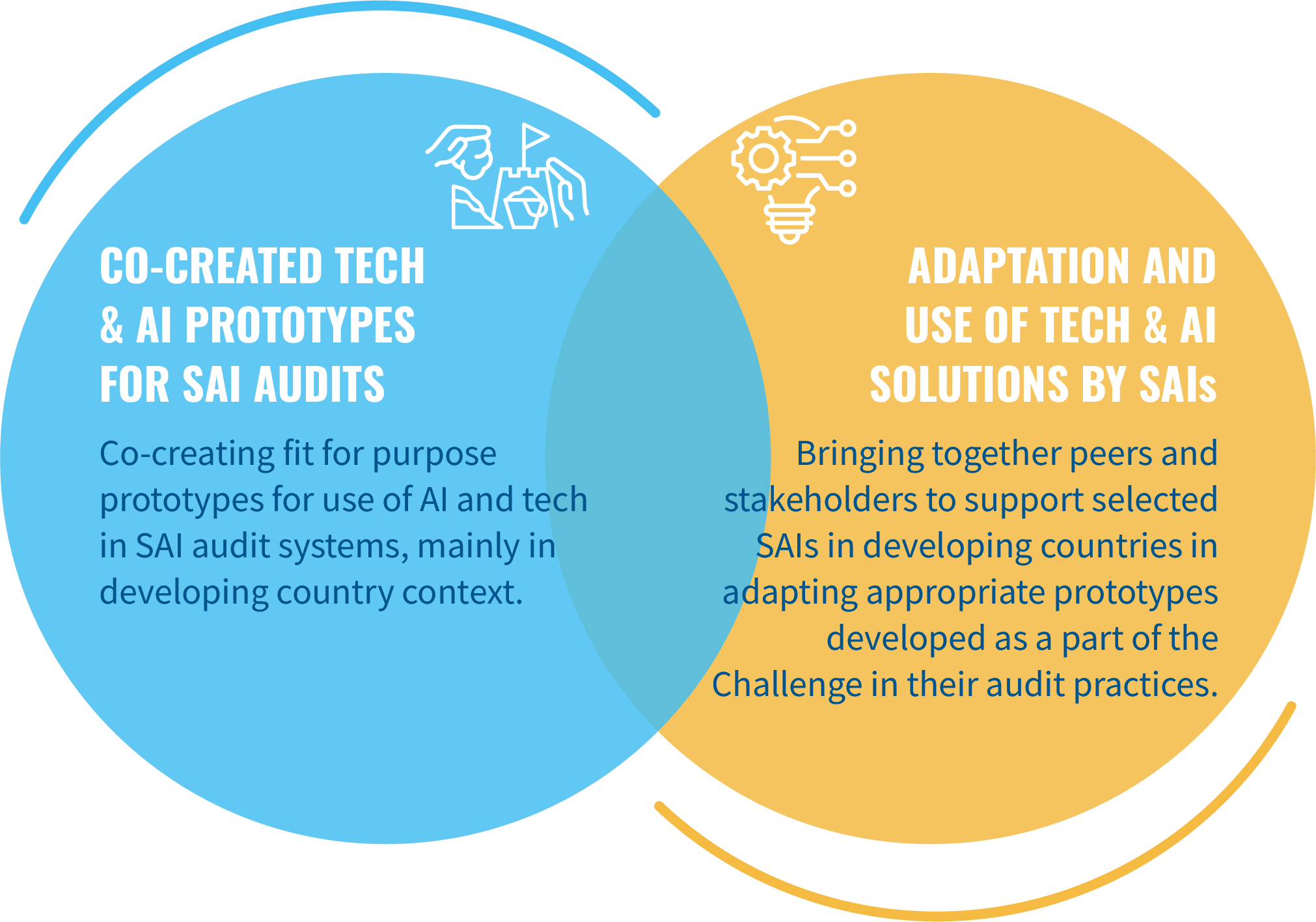
- The AI & Tech in Audit Challenge 2026 – 2027 combines two powerful formats In 2026 we will start with a global, hackathon‑style initiative bringing together 75 SAI auditors and technology/AI specialists into 15 multidisciplinary teams. Over six months, teams will design, test, and prototype practical solutions for use of tech and AI in SAI audit systems.
- In 2027 we will provide SAI level support to selected SAIs to adapt appropriate prototypes in their SAI audit systems.
The Challenge offers:
- A Sandbox providing a safe space for education & experimentation
- Mentorship from audit and AI & Tech experts
- Professional education across ten specialised audit‑tech tracks
- A global platform to pitch, refine, and showcase innovative prototypes
- SAI level support for adapting appropriate prototype in SAI audit systems
Participants will learn by doing working with peers from the community to solve real audit challenges using emerging technologies. All participants will receive professional education, mentorship, and access to a global network. All teams will develop a prototype.

WHAT DOES THE CHALLENGE LOOK LIKE?
15 Challenge Teams
We are aiming to put together 15 Challenge Teams. Each Challenge Team will consist of five participants drawn from different SAIs, regions, and external partner organisations to encourage diverse perspectives and cross-disciplinary collaboration. Each team will include:
1 Team Leader (from either audit or tech/AI background or both)
2 SAI Auditors with experience and/or expertise
2 Technology/AI experts from SAIs or external stakeholders
15 Challenges across ten tracks
Each team will define its own challenge statement, identifying a concrete problem or opportunity related to the use of technology and AI in the public audit ecosystem.
A Challenge Council will review and approve these proposed challenges to ensure they are well-scoped, relevant, and aligned with the overall objectives of the initiative. Once approved, teams will proceed to develop prototypes of AI-enabled tools, digital systems, or data-analytics approaches within one of the ten thematic tracks.
TEN THEMATIC TRACKS
1. AI & tech in financial audit
Develop AI and technology solutions to enhance the efficiency and effectiveness of financial statement audits within SAIs. The prototype can be developed for any part of the financial audit process, including risk assessment, audit planning, data extraction and testing, anomaly detection, sampling, evaluation of audit evidence, forming audit opinions, and reporting.
2. AI & tech in performance audit
Develop AI and technology solutions to enhance the efficiency and effectiveness of SAI performance audit practices. The prototype can be developed for any part of the performance audit process, including horizon scanning, strategic portfolio development, audit planning, evidence gathering, data analysis to support conclusions, framing recommendations, data visualisation, follow up, communication with stakeholders, and stakeholder mapping.
3. AI & tech in compliance audit
Develop AI and technology solutions to enhance
audits that assess compliance with laws, regulations, policies, and procedures. The prototype can be developed for any part of the compliance audit process, including selection of audit topics or the subject matter, audit planning, gathering and evaluating evidence,
use of data analytics, analysis of non-compliance patterns, formulation of conclusion and recommendations,
and reporting and follow-up.
4. AI & tech in systems of audit quality management
Develop AI and technology solutions to strengthen systems of audit quality management within SAIs. The prototype can be developed for any part of the system of quality management, including establishing quality objectives, identifying and assessing quality risks, designing and implementing responses, monitoring the system and remedying deficiencies, evaluating its effectiveness.
5. AI & tech in strategic audit planning
Develop AI and technology solutions to enhance strategic and annual audit planning within SAIs. The prototype can be developed for any part of the strategic planning process, including audit universe mapping, risk assessment, prioritisation of audit topics, portfolio development, resource allocation, and horizon scanning.
6. AI & tech in follow-up systems
Develop AI and technology solutions to enhance the tracking and monitoring of audit recommendation implementation. The prototype can be developed for any part of the follow up process, including recommendation tracking, monitoring implementation progress, verification of actions taken, analysis of implementation rates, and reporting on audit impact.
7. AI & tech in demonstrating audit impact
Develop AI and technology solutions to strengthen how SAIs measure, communicate, and demonstrate the value and impact of audit work. The prototype can be developed for any part of the impact demonstration process, including impact measurement, data analysis, visualisation, public reporting, stakeholder communication, and narrative development.
8. AI & tech in auditing equal futures
Develop AI and technology solutions to support more inclusive, equitable, and gender responsive audit approaches. The prototype can be developed for any part of the audit process, including identification of equality related risks, data collection and analysis, assessment of disparities, evaluation of policy impacts, and reporting on inclusion and equity.
9. AI & tech in auditing to fight corruption
Develop AI and technology solutions to enhance the detection, prevention, and investigation of corruption and fraud in the public sector. The prototype can be developed for any part of the anti-corruption audit process, including corruption risk assessment, data analysis to detect anomalies, investigation support, monitoring of high risk areas, and reporting.
10. AI & tech in auditor education
Develop AI and technology solutions to enhance auditor education, professional development, and knowledge management within SAIs. The prototype can be developed for any part of the education process, including competency assessment, personalised learning, training delivery, simulation-based learning, knowledge sharing, and performance tracking.
AN IDI SANDBOX
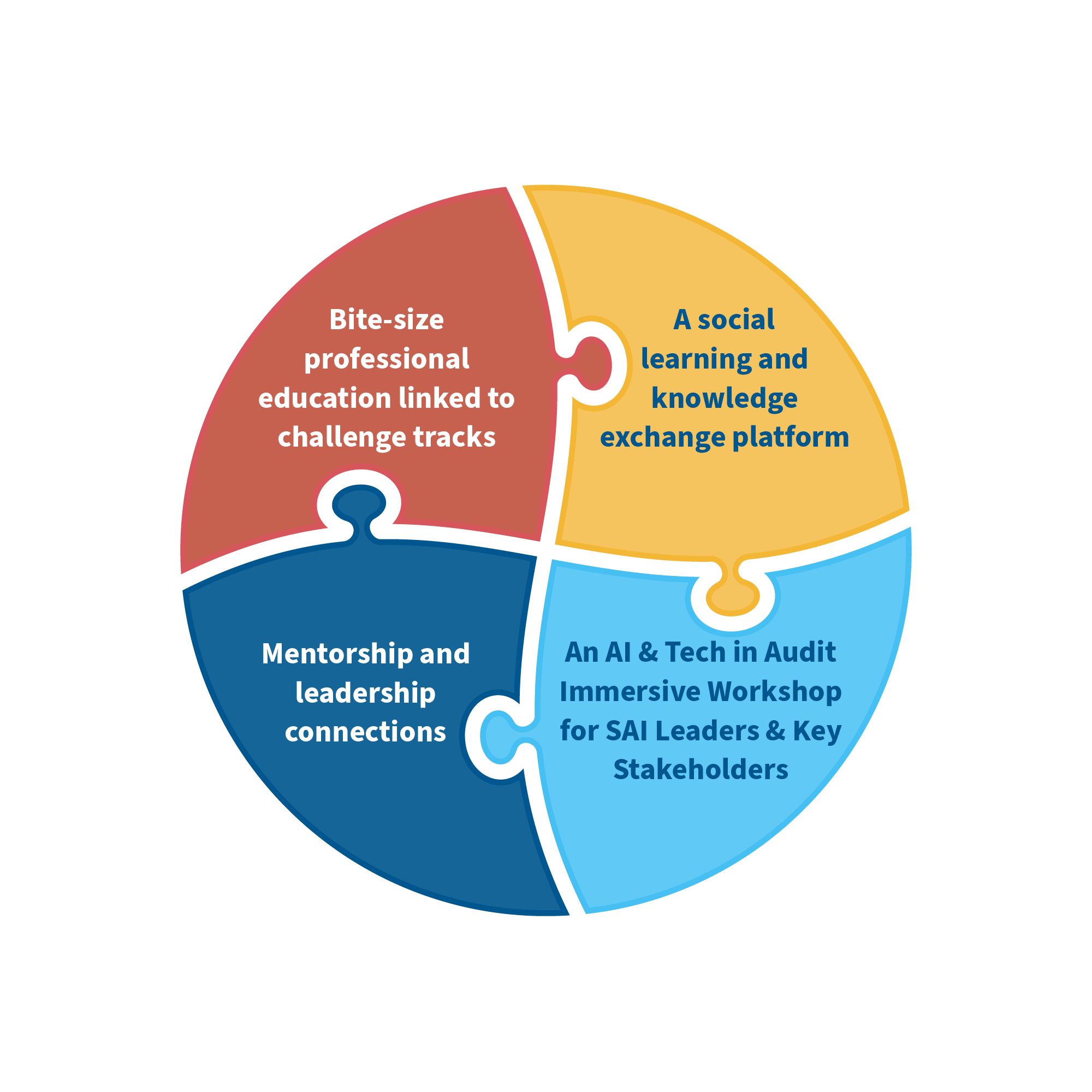
It is designed to give teams the space and guidance they need to access education, exchange knowledge, explore ideas and prototype AI‑enabled solutions aligned with their approved challenge statements. Within this Sandbox, participants can take risks, iterate quickly, and learn from peers and mentors without fear of failure.
The Sandbox will include four interconnected elements.
Leaving no one and no SAI behind
1. Inclusive participation
We will encourage SAIs to nominate gender-balanced teams and promote broad regional representation, ensuring participation from all INTOSAI regions.
This approach supports equitable access to the Challenge and helps cultivate diverse perspectives from the outset. To strengthen accountability and learning, we will also collect gender-disaggregated data for monitoring and reporting.
2. Inclusive mentorship
IDI will recruit a diverse core team and mentor pool, bringing together expertise from different regions, genders, and professional backgrounds. This ensures that every team receives guidance informed by a wide range of lived experiences and perspectives.
3. Inclusive Sandbox content
All learning materials will use inclusive language and incorporate dedicated modules on ethics and AI. Social learning will include a focus specifically on the needs and contexts of developing countries including Small Island Developing States (SIDS), ensuring that the curriculum speaks to diverse contexts.
4. Inclusive prototypes and solutions
Teams will be required to explicitly integrate gender and inclusion considerations into their final project pitches. This will help ensure that the AI solutions developed are not only technically sound but also ethically robust, socially responsible, and applicable in diverse SAI contexts.
5. Futures Audit track
A dedicated track for the Equal Futures Audit will be introduced, providing a focused space to advance gender equality and inclusion in audit practices and encourage innovation in this area.
6. Award criteria on mainstreaming inclusion
Gender and inclusion will be an explicit criterion for the award. This ensures that these principles are systematically assessed and rewarded across all submissions, reinforcing their importance throughout the initiative.