News
SAI Innovations journey to go F.A.R. continued with two marketplace events
19/12/2020
The IDI’s SAI Innovations 2020 theme ‘Innovative SAIs going F.A.R.’ was launched in November with two framing webinars.
This initiative discusses and showcases why innovations are needed, within the audit community and the public sector in general, keeping in mind all the time that the innovations are not the same for everyone and everywhere, but more fit-to-context and fit-to-purpose. The framing webinars set the tone of the theme and lead us to explore innovations more in marketplace events, in which different SAIs (Supreme Audit Institutions) and stakeholders are asked to share their innovative approaches and ways of working. (Please read more: https://idi.no/news/relevant-sais/sai-innovations/the-idi-held-two-webinars-for-sai-innovations-on-24th-and-25th-november)
The Innovative SAIs going F.A.R. journey continued in December with two very insightful marketplace events. The first of these, on December 9th, was hosted by the International Budget Partnership titled Harnessing the Power of Audits: Innovations in SAI-civil society cooperation and audit follow-up and presented by Ms. Claire Schouten, Senior Program Officer and invited speakers from the Office of the Auditor General of Nepal (Mr. Ramu Prasad Dotel, Deputy Auditor General) and Social Rights of Children in ACIJ – Civil Association for Equality and Justice (Ms. Natalia Escoffier, Coordinator). On December 14th SAI Costa Rica hosted the second marketplace session titled Rethinking the way we audit: experience in agile auditing presented by Ms. Carolina Retana Valverde and Mr. Alex Salomón Monge Lemaitre. Each webinar attracted over 100 participants keen to take the journey to go F.A.R.
In 2021 we’ll come back with further marketplace events, starting the first will be on January 20th at 15.00 CET with SAI Brazil and their experiences in the field of innovation and the 10 steps of innovation they have developed.
In the beginning of 2015, the Innovation Lab in SAI Brazil was created to bring innovation to the institution in order to face the VUCA world we live in.
During this event SAI Brazil will share their journey in creating the coLAB-i, designing a strategy to tackle the challenge of changing culture and mindsets and overcoming obstacles. Then, exploring the Lab two phases, SAI Brazil will show how they were able to deliver more effective products and services and our main projects.
Last but not least, SAI Brazil will present, from the lessons learned, what would be the 10 steps for innovation.
The registration to this event will start early January. Welcome to join us also in the New Year!
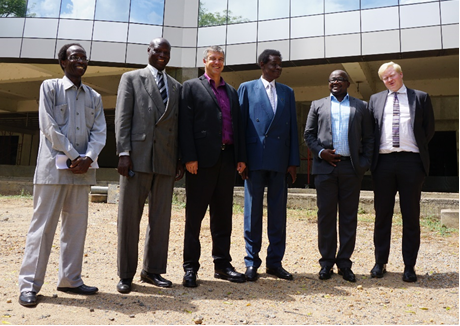
Evaluation of joint project highlights excellent work of peers along with several gaps and areas for improvement.
A joint project between the National Audit Chamber of South Sudan (NAC), the INTOSAI Development Initiative (IDI) and AFROSAI-E between 2017 and early 2020 has now been evaluated. According to the evaluation, the peers from IDI, AFROSAI-E, SAI Kenya and SAI Norway have provided excellent support and continued support from the present peers would be of great value. Still, the evaluation points to several areas of improvement and gaps in the overall goal achievement.
The overall objective of the project was to “Maintain and strengthen key audit-related capacities in NAC, to prepare NAC to play a strong role in the reform efforts of the Government of South Sudan to improve and sustain Public Financial Management Administration and accounting systems.” There were six expected outcomes of the project:
The evaluation was carried out by AB Professional and noted that during the project period, the NAC was highly challenged especially because the Government of South Sudan (GOSS) did not meet its funding commitments. For example, NAC staff did not receive their salaries on time and as at March 2020, they had not been paid for four months. In addition, funding for audit operations has not been adequate and hence staff have difficulties in getting transport to work, transport to auditees, there is limited access to the Internet, long periods of no electricity, no Internet at the NAC, occasionally no water in the office or toilets, and no adequate working environment and infrastructure in general.
The evaluation further noted that no audit reports from the NAC have been tabled in the Parliament since 2013 and even though audit reports are submitted to the President’s Office, the NAC is not invited to present these reports in Parliament, where they would be public documents. As such, the basic conditions for playing the role of a SAI are missing. IDI has therefore classified this project as ‘lifeline support’, which has the objective of maintaining the basic competency and skills of the SAI and its staff in the interim period till the situation stabilises and more long-term support can be provided.
Despite the label ‘lifeline support’, the Project had an ambitious Results framework. Of the planned audit reports for completion, a number were brought to printing stage by the time of the evaluation (they were printed afterwards). Other key deliverables were also achieved for example, the NAC prepared a Strategic Plan for 2019-2024 and a Stakeholder Engagement Strategy, the generic AFROSAI-E performance audit manual and human resource development manual were customised for on-the-job training and future use in NAC, the Human Resource Development Strategy was prepared, the NAC annual performance report covering 2005-2018 was completed and issued, staff undertook training courses with AFROSAI-E. and key auditees and PAC members were sensitised on NAC functions and the handling of its reports. However, the risks were underestimated in the project description and as such, so many of the targets have not been fully achieved. Despite the few delayed deliverables, the results are so far positive considering the challenging situation within which the NAC operates.
On the overall goal achievement, the evaluation had four conclusions; (1) the two indicators of goal achievement were not appropriate for measuring the overall success of the project, (2) measurement has not been done in accordance with the definitions, (3) figures that are used in the reporting are of questionable reliability, and (4) the overall achievement of the formal goals is low, but mainly attributable to causes outside the project management’s area of influence.
The evaluator further pointed out that there has been no attention to advancing gender equity in the NAC since no indicator on gender was included in the Cooperation Agreement nor in the Results Framework in the Grant Agreement between the Ministry of Foreign Affairs of Norway (MFA) and the IDI. The NAC has developed a new Strategic Plan (SP) 2019-2024, which also makes no reference to gender issues. According to the evaluator, the SP should be reviewed based on a proper gender analysis and an Addendum added. The importance of gender equality should be advocated with emphasis and the way forward clearly spelt out in strategic and operational plans.
Furthermore, the evaluator noted that it was relevant to provide ‘lifeline support’ during 2017-2019. However, if the NAC is not provided with the basic resources for fulfilling its role as SAI by the government, it will be unable to complete outstanding audits and the drain of trained auditors will continue. While the future role of the NAC and its obligation to report directly to the legislature is under high-level discussion, it can continue to issue its reports to the Executive authorities and start building demand for accountability through other avenues such as civil society organisations. Thus, the proposed second phase of the Peer-support project – the “NAC Strategic Change project 2020-2024”[1] should be conditional on full and continuous funding from the GOSS for all staff, adequate office space and transport as well as other operational costs. This condition is vital if the proposed project is to be successful and the project should be terminated on three months’ notice if the condition is not met.
For future support, the evaluator concluded that the IDI is the actor that is best positioned to be responsible for the support in the next phase. The peers from IDI, AFROSAI-E, SAI Kenya and SAI Norway have provided excellent support and continued support from the present peers would be of great value. However, auditors are not experts in all areas where support is needed and thus, adequate expertise should be engaged for (among others) organisational development and development of internal and external processes.
Monitoring and evaluation are important elements in the project cycle and provide reflection on the performance of the project. Evaluation enables the project to receive independent feedback on the relevance, effectiveness, efficiency and/or consistency of the project. Monitoring the Peer-support project has been a challenge, and hence in the proposed second phase of the project, consideration should be made to include an ongoing evaluation[2], that continuously provides feedback to the project management and facilitates the learning process.
The project is presented in more detail here in the final project report. This report also includes the action plan for each of the recommendations of the evaluation.
[1] NAC Strategic Change Project 2020-2024, Cooperation Agreement, signed 23 August 2019
[2] Ongoing evaluation is one of the three state of the art types of evaluation (the other two are ex ante and ex post evaluations). It means that the evaluation is ongoing during the project period. Ongoing evaluation is “a source of feedback, a tool for improving performance, an early warning of problems (and solutions) and a way of systematising knowledge” (European Commission: Practical Handbook for Ongoing Evaluation). In conjunction with evaluation information, effective monitoring and reporting provide decision-makers and stakeholders with the knowledge they need to identify whether the implementation and outcomes of the project are unfolding as expected and to manage the initiative on an ongoing basis. Especially when there are external risks that are significant threats to achieving the goals it is quite common to include an ongoing evaluation as a component of a project. An alternative is a Mid-Term Evaluation, which can be implemented at any time.
 |
For more information on IDI’s work in South Sudan, click here. |
IDI has been supporting Supreme Audit Institutions (SAIs) primarily in the developing countries to implement International Standards of Supreme Audit Institutions (ISSAIs) since 2012 under its 3i Programme. This year the IDI has transitioned from programme-based delivery approach to continuous workstreams based support. There are four workstreams under its Strategic Plan 2019-23. The development and maintenance of global public goods for ISSAI implementation remains at the heart of Professional SAIs workstream.
Financial Audit ISSAI Implementation Handbook is one such another product. The Handbook is an audit methodology that contains explanations of the ISSAI financial audit process as well as audit working paper templates, that are designed to facilitate the application of ISSAIs in practice. The methodology suggested in this Handbook extensively covers the audit work to be performed and documented at an audit engagement level. Following the endorsement of INTOSAI Framework of Professional Pronouncement (IFPP) in 2019, IDI carried out the light touch review of Financial Audit ISSAI Implementation Handbook in 2020 to reflect the new numbering system of Financial Audit ISSAIs among other minor updates. The updated version of this handbook is available on https://idi.no/elibrary/professional-sais/issai-implementation-handbooks/handbooks-english/1118-financial-audit-issai-implementation-handbook-version-1-english-light-touch-review-2020/file for use by our SAIs.
The translated version of this Handbook in Arabic, French and Spanish will be available soon.

Demonstrating its resilience during COVID 19, the IDI is conducting a SAI PMF basic training course virtually from 7 to 11 December 2020.
Facilitated by IDI staff and two external experts, 35 participants from all over the world will learn about the basics of applying the SAI PMF methodology during the five days intensive course.
This course was designed to be attended by all interested parties: donor agencies, SAIs, consultants, individuals as well as other organisations interested in the work done by SAIs. The objective of targeting this training to all interested parties, including SAI staff, stems from the recognition of the key role various organisations and individuals play in strengthening the capacity of audit institutions. It is therefore envisaged that this training will provide the participants with the knowledge that puts them in a better position to advocate and support the use of SAI PMF for measuring the performance of SAIs. By measuring their performance, SAIs can establish whether their practices match the requirements of international standards for strong and effective SAIs that add value to the lives of citizens.
IDI has been supporting Supreme Audit Institutions (SAIs) in the developing countries to implement International Standards of Supreme Audit Institutions (ISSAIs) since 2012 under its 3i Programme.
The IDI has transitioned from programme-based delivery approach to continuous workstreams based support. There are four workstreams under its Strategic Plan 2019-23. The development and maintenance of global public goods for ISSAI implementation remains at the heart of Professional SAIs workstream.
Financial Audit ISSAI Compliance Assessment Tool (iCAT) and Guidance is one such product, which can be used by the Supreme Audit Institutions (SAIs) to determine the applicable ISSAIs in their environment and assessing the ISSAI implementation needs. The IDI has developed Financial Audit iCAT and Guidance-Version 1, which was published in 2018. Following the endorsement of INTOSAI Framework of Professional Pronouncement (IFPP) in 2019, IDI carried out the light touch review of Financial Audit iCAT in 2020 to reflect the new numbering system of Financial Audit ISSAIs among other minor updates. The updated version of this tool is available on https://idi.no/elibrary/professional-sais/icats/icats-english/1117-200227-idi-fa-icat-v1-english-lt-revision for use by our SAIs.
The translated version of this updated tool and guidance in Arabic, French and Spanish will be available soon.
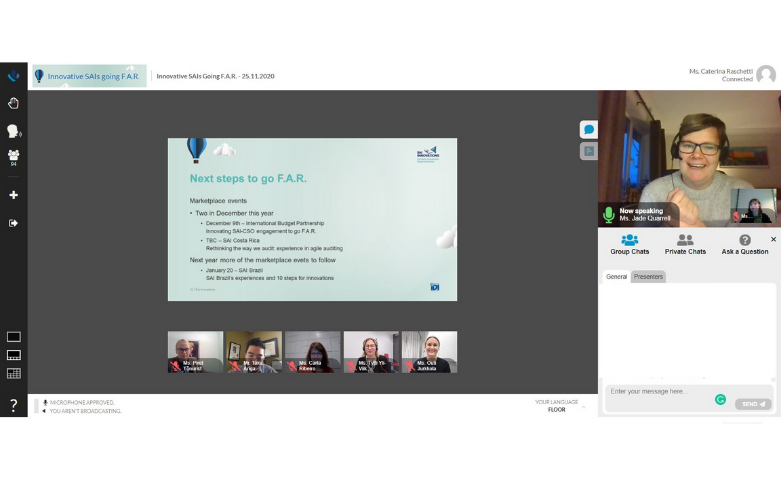
The IDI held two webinars for SAI Innovations on 24th and 25th November. The webinars focused on this year’s theme of Innovative SAIs going F.A.R.
Two hundred and fifty participants joined the webinars that set the scene for meaningful and open conversations on flexibility, agility and resilience of SAIs for staying relevant in the current circumstances.
The webinars are aimed at sparking interest and reflecting on what it takes – both at the organisational and individual staff level – to innovate in these challenging times. Speakers shared reflections on why innovations and being innovative is so crucial for SAIs and public sector in general and what role the SAI can have in supporting innovation. They reflected on innovation in different areas of an SAI’s work – from technological to social to methodological. Underlying these reflections is a firm belief that each SAI in the INTOSAI community has the potential to be innovative. Each SAI’s path would need to be fit-for-purpose and fit-for-context.
The webinars centred around a panel discussion moderated by Tytti Yli-Viikari, Auditor General, National Audit Office of Finland. The panellists were:
Piret Tõnurist, PhD, Project Manager, Lead on Systems Thinking and Anticipatory Innovation Governance, OECD’s Observatory of Public Sector Innovation
Taka Ariga, Chief Data Scientist, Director, Innovation Lab, US Government Accountability Office
Carla Motta, Designer, Federal Auditor, Innovation Lab – coLAB-i, Brazilian Court of Account
Aida Maria Talavera, Director in the Project Management Office of the Office of the Chairperson in the Commission on Audit of the Philippines
The next steps in the Innovative SAIs going F.A.R. journey are the Innovation Marketplace events.
In the Innovation Marketplace events SAIs and stakeholders will share the innovations that they have tried out and the lessons they have learned. Come and join us sharing your experiences, ways of doing (innovative) things and new ideas!
We have two Marketplace events scheduled for December:
Wednesday, 9th December 2020 | 15.00 CET
Harnessing the Power of Audits: Innovations in SAI-civil society cooperation and audit follow-up // International Budget Partnership
How can we strengthen stakeholder engagement and audit impact? This session will bring together SAIs and civil society actors to share innovations and lessons in oversight collaboration and audit follow-up. Speakers include representatives from the Office of the Auditor General of Nepal, the International Budget Partnership and the Asociación Civil por la Igualdad y la Justicia in Argentina.
Monday, 14th December 2020 | 15.00 CET
Rethinking the way we audit: experience in agile auditing // SAI Costa Rica
The new global context challenged us to rethink our way of auditing, and we found answers in the agile approach. This has allowed us to continue adding public value to our stakeholders and staying relevant. We have integrated into the audit process some principles, values, and tools that lead us to agile working cycles, for earlier and continuous delivery of executive reports, to trigger timely improvements by the auditees. Our main maxims are: change is welcome; focus on the simple and essential; empathic approach with the audited entity; collaborative work to get the products done; effective face-to-face communication; motivated individuals; and continuous attention to technical excellence in accordance with fundamental principles of the ISSAI 100.
We look forward to seeing you at these webinars!
Please register here by 8th December at 12.00 CET
The INTOSAI Global Survey Committee invites all SAIs to respond the 2020 INTOSAI Global Survey by the 18 December.
The 2020 INTOSAI Global Survey is currently underway!
When SAIs participate in the survey, they are supporting the improvement and further development of IDI and INTOSAI organisations´ Strategic plans. Additionally, they help identify global and regional challenges, opportunities and trends as well as SAI performance and capacities needs.
SAIs can respond to the survey progressively during this period by clicking on the “pause” button at the end of each page, save the URL and then come back to the survey as many times as needed until they finish.
If necessary, you can seek support for completing this survey from the regional secretariat. If you have any comments or questions, please contact me, IDI Global Foundations Manager Marcela Hommefoss (marcela.mora@idi.no) / Mobile phone: +47 97107626 or Manager Camilla Fredriksen (camilla.fredriksen@idi.no) / Mobile phone: +47 41234866.
To the take the survey see link below for each language:
English version: https://s.chkmkt.com/?e=190276&d=e&h=AEA37E3079B61F3&l=en
Spanish version: https://s.chkmkt.com/?e=190276&d=e&h=AEA37E3079B61F3&l=mx
Arabic Version: https://s.chkmkt.com/?e=190276&d=e&h=AEA37E3079B61F3&l=ar
French Version: https://s.chkmkt.com/?e=190276&d=e&h=AEA37E3079B61F3&l=fr
For more information see our page https://idi.no/idi-global-foundations/global-survey-and-stocktaking-report
IDI is concerned that recent events may negatively affect the independence of the Ghana Audit Service
The INTOSAI Development Initiative (IDI) has today released a statement regarding the current situation involving the Ghana Audit Service and the Auditor General of Ghana, Mr. Daniel Yaw Domelevo.
The statement, signed by IDI Director General Einar Gørrissen, expresses concern over the potential negative effects recent events may have on the independence of the Ghana Audit Service. It encourages all parties to follow all applicable laws and principles which currently exist to safeguard the independence of the Ghana Audit Service and the work of the Auditor General. Independence is a critical prerequisite for a Supreme Audit Institution (SAI), such as the Ghana Audit Service, to function effectively and provide real value to citizens.
The statement can be read in full below:
IDI Statement on the Current Situation at the Ghana Audit Service
IDI is the capacity development arm of the International Organization of Supreme Audit Institutions. We have a global mandate to enhance the capacity and performance of developing country SAIs and to advocate for the independence of SAIs. For more information, please see our Introduction to IDI. For additional comments, please get in touch with IDI.
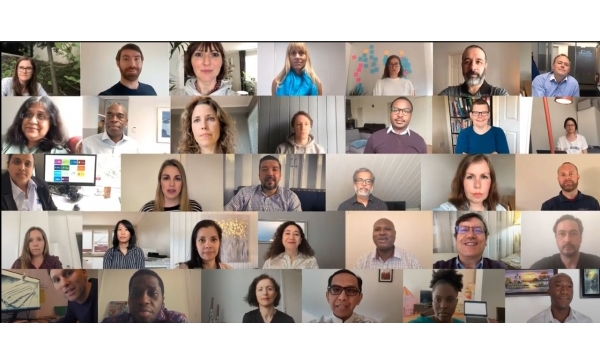
We are in this together
As SAIs continue to do their utmost to work as effectively as possible under these difficult circumstances we want you to know that everyone at IDI is here for you. We have a special video message for you.
{youtube}https://www.youtube.com/watch?v=5qnVvWwMAAk|600|450|1{/youtube}
Stay tuned, stay safe!
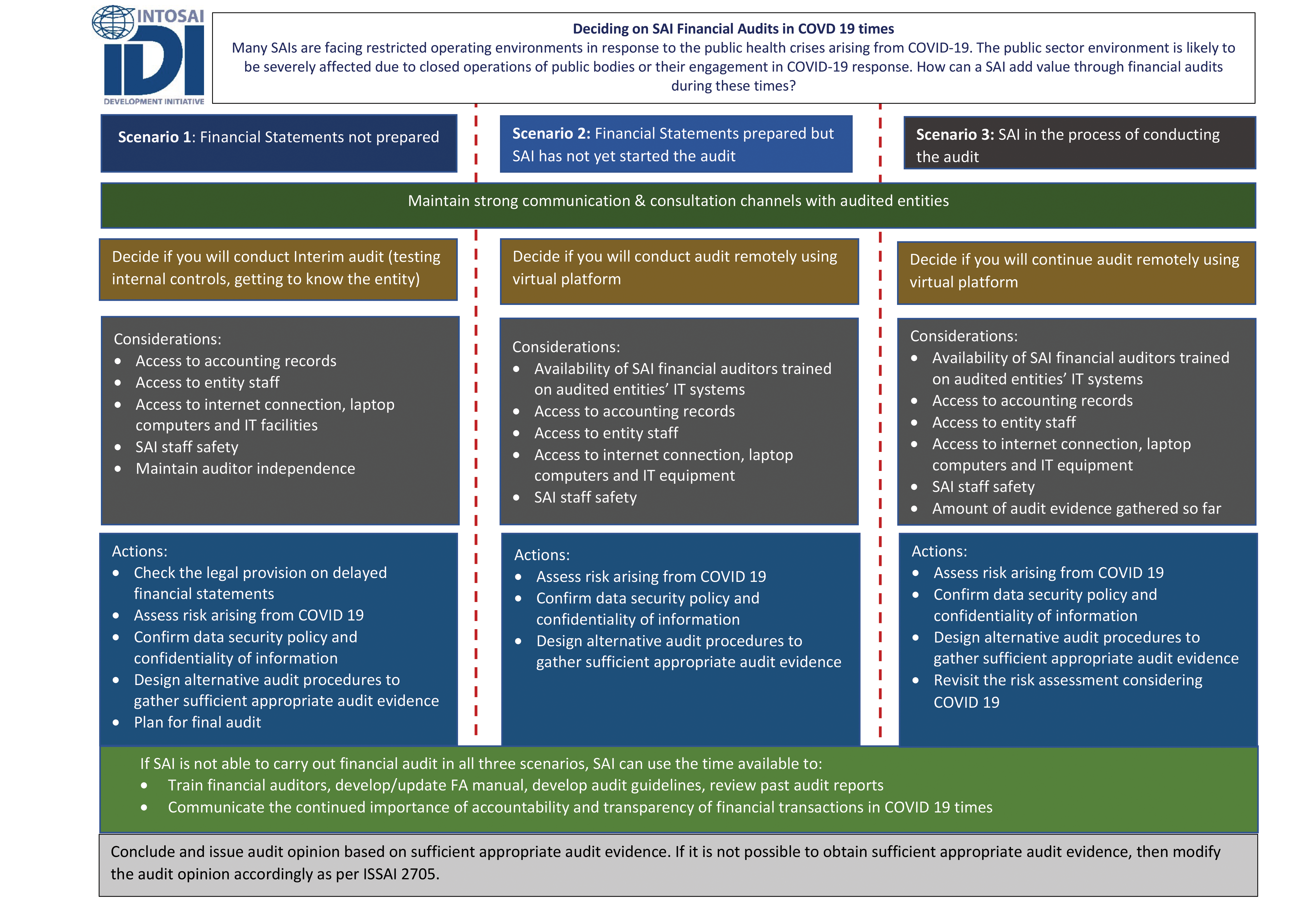
Deciding on SAI Financial Audits in COVID-19 times.
Like most organisations, SAIs have been severely affected by the spread of COVID-19. SAIs are trying to prioritise protecting the physical health and well-being of staff and to contribute to efforts to limit the spread of the virus whilst delivering value and benefits to citizens.? SAIs continue to do their utmost to work as effectively as possible under these difficult circumstances.
To respond to COVID-19 challenges and to help SAIs remain relevant under such situation, IDI will produce a series of practical guidance and technical resources under its 3i COVID-19 Response Actions. The first in the series is about ‘ Deciding SAI Financial Audits in COVID-19 times‘, which was published on IDI website on 21 April 2020.
COVID-19 presents?challenges?to?SAI?financial auditors who are obliged to work within an annual financial reporting cycle?determined by?statutory requirements. SAIs?must?ask to what extent can statutory requirements be compromised?or amended??Should they work towards?statutory requirements?or wait for?the situation to return to normal??In many cases, the strategic decision of the SAI will depend on reporting deadlines?and therefore the current stage of annual?audits. ‘Deciding SAI Financial Audits in COVID-19 times’ is a guide for SAIs in making these decisions based on their situation.
Over the coming weeks, we plan to publish more documents related to compliance and performance audits, build virtual workspace on our LMS, host webinars and other online interactions.
Prof Stay tuned, stay safe!