LOTA – Leveraging on Technological Advancement

The audit of information technology systems, controls, and processes, also referred to as an IT audit, has become one of the central themes of audits being conducted by Supreme Audit Institutions (SAIs) across the world. This is a natural response to the critical reliance on IT systems to support government and public sector organisations. The IT systems being used should protect the organisation’s data and assets as well as support mission, financial, and other specific goals.
While the increasing use of IT has led to improved business efficiency and more effective service delivery, it has also brought with it risks and vulnerabilities associated with, for example, the digitalisation of services and the increased connectivity to other internal and external systems and networks. The role of IT audit in providing assurance that appropriate processes are in place to manage the relevant IT risks and vulnerabilities is essential if the SAI is to report meaningfully on the efficiency and effectiveness of government and public sector operations.
In 2014, the International Organization of Supreme Audit Institutions (INTOSAI) Working Group on IT Audit (WGITA) and the INTOSAI Development Initiative (IDI) jointly worked to produce the first Handbook on IT Audit with the goal to provide SAI auditors with standards and universally-recognised good practices on IT audit. This 2022 version of the handbook provides an update to the explanations of the major areas that IT auditors may be required to look into while conducting IT audits.
The WGITA/IDI handbook follows the general auditing principles as laid down under the International Standards for Supreme Audit Institutions (ISSAI). The handbook also draws from the internationally recognised IT frameworks, including ISACA’s COBIT framework, International Standards Organisation (ISO) standards, and IT guides and manuals of some of the SAIs, in an attempt to provide the users with essential information and key questions needed for the effective planning and performance of IT audits.
The project to update this handbook was led by the chair of WGITA, namely SAI India, SAI of the United States of America, and the IDI. WGITA and the IDI wish to thank the individual members of the team who worked relentlessly in developing this guidance. IT auditors from the SAIs of Australia, Brazil, Fiji, India, Kuwait, Philippines, Tanzania, and the United States of America have contributed valuably by providing IT audit report examples. Many thanks also go to the SAIs that provided their valuable feedback and comments on the handbook.
IDI and WGITA will conduct a light touch review of this handbook on a biennial basis. If there are substantial changes to be made, IDI-WGITA may decide to work on a revised version of the handbook. Such decisions will be taken on the basis of the biennial review.
In response to this rapidly changing environment and technology development, IDI has developed a LOTA Scan Tool to help SAIs in making better use of technology in fulfilling their audit mandates, by planning technology-specific audits, developing technology skills and introducing new technologies into the SAI audit practice.
The LOTA Scan aims to provide SAIs with a tool to analyse their internal and external environment in the use technology in audits and use of technology by governments. The LOTA Scan part related to external environment assessment helps to identify areas where technology audits are required and outlining technology-related audit projects to be included in LOTA Strategy. At the same time, external environment assessment helps to identify the technological needs of SAI for using technology in audits. In turn, the internal environment assessment helps to assess the current state at the SAI and how well SAI responds to the technological needs arising from the external environment.
The LOTA Scan Tool consists of
The more information on these items along with download links may be found below.

Kathleen
LOTA Pioneer
We visualise LOTA Pioneers as SAI auditors driving change for leveraging on technological advancement in their SAIs’ audit work. A LOTA Pioneer will be an effective accountable and inclusive SAI auditor who strategizes for digital transformation in audits and brings technology into the SAI audit world. LOTA Pioneers will be expected to demonstrate the set of competencies listed below.

Aliyah
LOTA Pioneer
LOTA Pioneers (2023-2024) is one of the main vehicles for realizing the LOTA vision.
It is an initiative that aims to facilitate the transformation of a SAI auditors into change agents who bring technology to SAI’s audit world by scanning their internal and external audit environments to strategize for leveraging on technology in audits and auditing the use of technology by governments.
To begin with this initiative will be offered in English for up to 25 SAIs. Each SAI is requested to nominate two persons from different leadership levels in the SAI. While one will act as LOTA Pioneer (Strategy), the other will act as LOTA Pioneer (Audit).
Besides creating a pool of LOTA Pioneers, this initiative is expected to result in LOTA scans, LOTA strategies and LOTA audits at the participating SAI level.
Those candidates who successfully complete their education, LOTA scan / strategy and audit will graduate as IDI’s LOTA Pioneers and become a part of an alumni network.
A functional leader who has the position and willingness to strategize for using technology in SAI Audits and auditing use of technology on a sustainable basis in the SAI. She/He would have the capacity to lead a team to use the LOTA scan tool for developing a LOTA strategy for SAI audits. LOTA is the SAI’s strategy for including audits of technology in the SAI’s strategic and annual audit plan on a regularly basis. In the long term the change strategy is expected to institutionalize the use of technology in audit and audit of high priority areas of use of technology by governments.
An audit team leader with the ability to conduct ISSAI based audits of technology or audits using technology. IDI will provide professional education to the pioneers and support them in conducting LOTA scan to develop LOTA strategy and conducting a LOTA audit on a high priority area.
LOTA Pioneers benefit both – SAIs and SAI Auditors. Let’s take a look in more detail.

Jin
LOTA Pioneer
IDI will grow LOTA Pioneers through the combination of
More information on each of the LOTA Pioneers component can be found in the section below.
LOTA Pioneers process includes the components listed below.
IDI will provide each LOTA Pioneer with professional education to develop competencies as LOTA Pioneers and mentoring support to carry out their scan, strategy and audit assignments successfully. Together with experts from, within and outside the INTOSAI community, we have developed a syllabus mapped to the competency framework for LOTA Pioneers. This syllabus will be delivered through professional education modules, social learning sessions and on the job support in a blend of online and in person formats.
Each auditor participating in LOTA Pioneers will cover the modules related to being an effective, accountable, and inclusive LOTA Pioneer, followed by a deep dive into two tracks:
a) Strategize for digital transformation in audits track provides LOTA Pioneer with competencies required to conduct LOTA Scan and lead the strategic change in the organization.
b) Bringing technology into the audit world track provides LOTA Pioneer with competencies required to conduct LOTA Audits either using data analysis in SAI audits or conducting audits of IT systems. This track covers
Based on their learning and reflections, the LOTA Pioneers will:
Besides LOTA Mentors, LOTA Pioneers will act as LOTA Accountability Buddies for each other. They will support each other’s journey, nudge each other into action and successful completion of their projects.
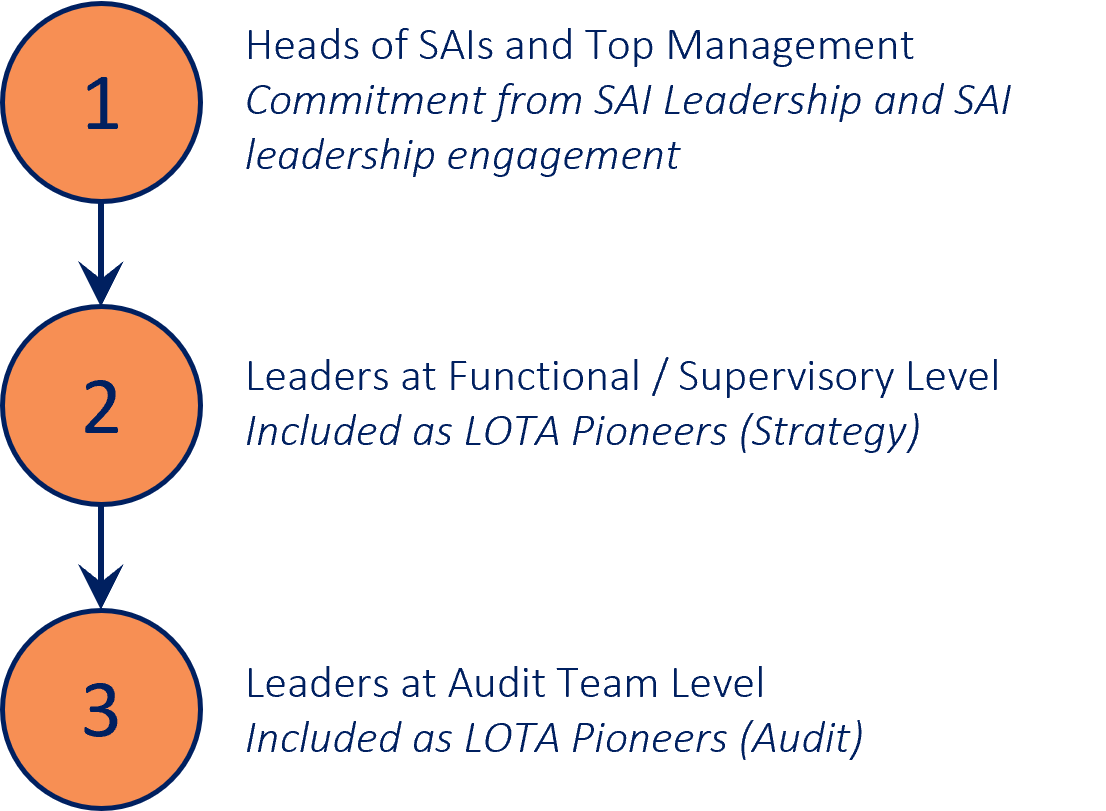
Successful transformation and change initiatives require sponsorship and support throughout the SAI leadership chain. Through this initiative the IDI plans to reach out to three levels of SAI leadership
IDI will give out LOTA Pioneers Awards for LOTA Strategy and LOTA Audit.
LOTA Pioneers Alumni will provide space for fostering a professional network of pioneers across the cohorts and facilitating their continuous professional development. This alumni network will be connected to LOTA Connect which is visualized as a broader network of technology and audit professionals.
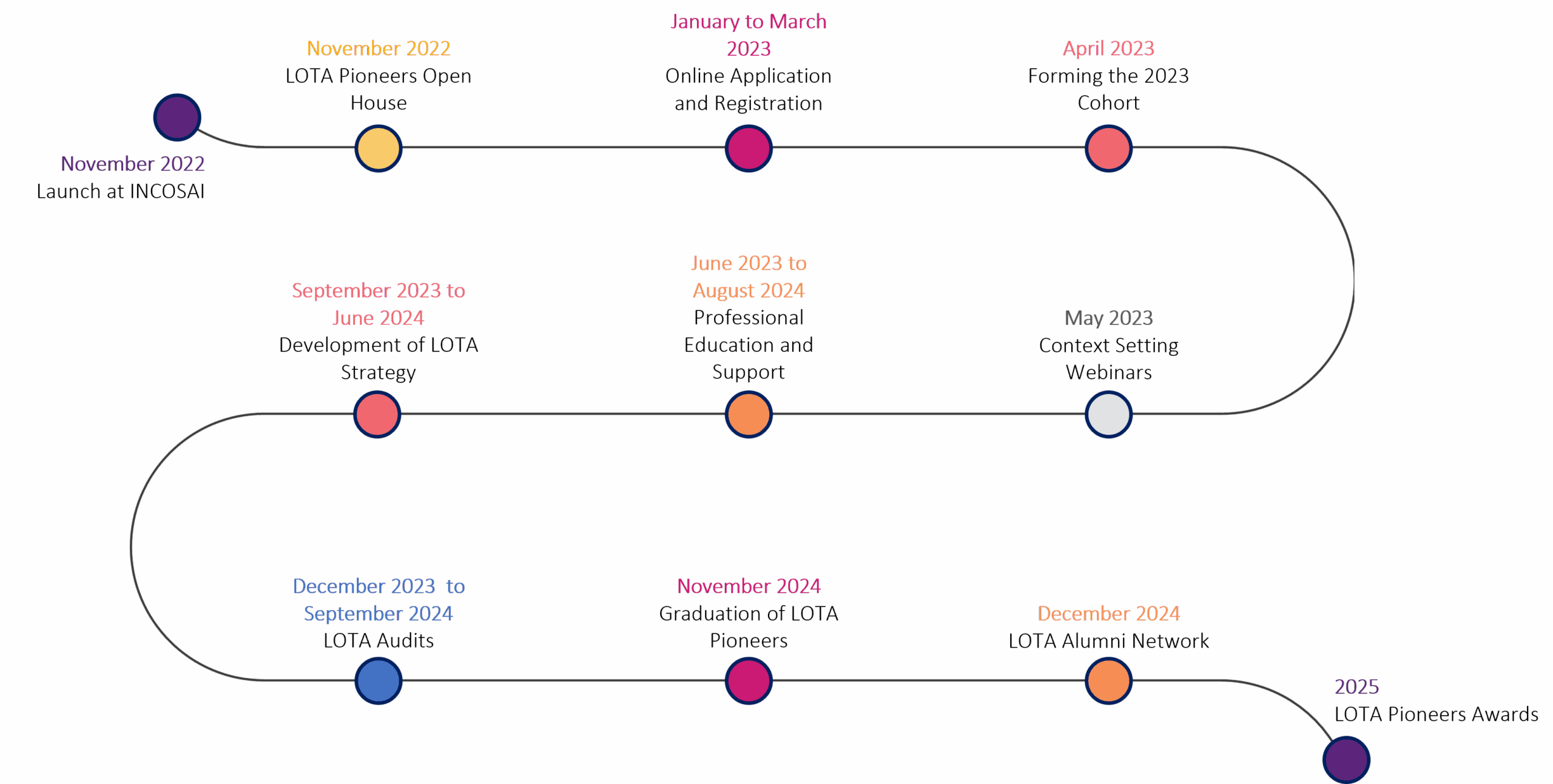
Please see the timeline for the LOTA Pioneers 2023-2024 batch below.

Galaxy
LOTA Pioneer
Please nominate a LOTA Pioneers (Strategy) who …
Please nominate a LOTA Pioneers (Audit) who …
We see SAIs as key partners in the development of change agents that will lead digital transformation in SAI Audits. LOTA Pioneers can take care of a part of the education that SAIs need to build an initial technology skills and knowledge, but SAIs needs to take care of local context, provide necessary support during assignment execution, and ensure sustainable technological change.
We seek the commitments from SAIs that are mentioned below.
Candidates who successfully complete the professional education and complete their assignments of developing LOTA Strategy and conducting LOTA Audit will graduate as LOTA Pioneers (Strategy) and LOTA Pioneers (Audit). They will become a part of the alumni network and eligible to apply for the LOTA award. We hope that they will contribute to LOTA actions at the SAI, regional and IDI level.
We encourage SAIs to nominate qualified women candidates.


Hassan
LOTA Pioneer
LOTA Pioneer 2023-2024 is now open and SAIs should have received Invitation packages by now.
SAIs may nominate 2 Auditors by accomplishing the form through the button below.
In completing the form, SAIs will be requested to submit the following files:
As mentioned in the announcement, the IDI will review the applications and select 25 SAIs (50 candidates) for participation in the SAI Pioneers 2023-2024. The IDI will use the following criteria in selecting SAIs:
For qualification criteria for LOTA Pioneers (Strategy and Audit) please refer to the LOTA Pioneers Announcement.
Please also see the announcement for an outline of costs covered by the IDI.
We request you to kindly arrange to send us all requested documents (SAI Commitment and Nomination form, SAI Pioneers application letters, and CVs) no later than 31 March 2023. Please ensure that the details of each of the nominees are uploaded in the form through the button below. We will unfortunately not be able to consider applications received after the indicated timeline.
If you have any questions or doubts about LOTA Pioneer please contact IDI LOTA team at lo-ta@idi.no
We hope you will join us on this journey of SAI audits digital transformation for the benefit of all!

Robert
LOTA Pioneer
We live in a constantly changing world and Supreme Audit Institutions need to adapt to changes if they want to stay relevant. Exponential technological advancement has been changing the way we live and with the Covid-19 crisis, this process has only been accelerated. With technological advancements, organizations and people must store, organize, and use enormous volumes of data, process this data faster and safer than ever before, use a variety of tools and technologies, and cope with greater speed of change.
Governments around the globe are also investing in technology and introducing new systems. On the one side, investments in technology can help governments to optimize their functions, automate processes, and provide better services for their citizens. On the other side, digital solutions may be vulnerable to external attacks, corruption and create new levels of complexity and exclusion.
This demands that SAI’s obtain new skills and knowledge to cope with these new audit subjects. Therefore, it is important for SAIs to understand the technological change around them, to assess the implications of this change for their audit working, to leverage on technological advancement in SAI audits, and to be able to audit technologies employed by governments.
For SAIs it is important to understand the technological change around them, to assess the implications of this change for their working, to leverage on technological advancement in SAI audits and to be able to audit technologies employed by the government.
SAIs stay relevant by a) leveraging on and b) auditing technological advancements
In the LOTA initiative we will work towards the vision of seeing
Embedded within this vision is our vision of seeing SAIs mainstream gender and inclusiveness considerations in their use of technology and SAIs contributing to mainstreaming of gender and inclusiveness considerations through their audits.
Demystifying Technologies is a brochure that aims to provide a concise visual guide for SAI professionals on some technologies that are relevant for public auditors and might impact their work, while also establishing a common vocabulary.
It is primarily intended to provide a high-level overview of key technologies and concepts for non-technology professionals or non-technology Auditors.
For further information regarding the featured technologies, their use cases, and audit-related information, please refer to the links provided in the Other Resources section.
For any questions please contact us at lo-ta@idi.no.