| Criterios de designación | Descripción |
|---|---|
| Experiencia en auditoría | Capacidad para implementar lo aprendido en su labor y añadir valor a la EFS. Si bien no se establece un límite en cuanto a la cantidad mínima de años previos al retiro de la persona designada, se insta a que las EFS reflexionen acerca de en qué personas quieren invertir tiempo y recursos en beneficio de la institución. |
| Habilidades idiomáticas | La persona nominada deberá estar en condiciones de expresarse y escribir adecuadamente en español. |
| Aptitudes relacionadas con TI | La persona nominada deberá tener un adecuado conocimiento funcional sobre computadoras y estar en condiciones de utilizar Internet y productos de Microsoft Office, por ejemplo, Word, PowerPoint y Excel. |
| Disponibilidad de la persona que se desempeñe como Coach | Será necesario que las personas participantes en PESA cuenten con un/una coach que se desempeñe según las expectativas de PESA. |
| Criterios de designación | Descripción |
|---|---|
| Experiencia en auditoría | Una persona auditora con experiencia técnica en auditoría de cumplimiento, financiera o de desempeño. |
| Habilidades idiomáticas | La persona que se desempeñe como coach deberá estar en condiciones de expresarse y escribir adecuadamente en español. |
| Aptitudes relacionadas con TI | La persona que se desempeñe como coach deberá tener un adecuado conocimiento funcional sobre computadoras y estar en condiciones de utilizar Internet y los productos de Microsoft Office. |
| En condiciones de brindar apoyo | El/la coach deberá estar en una posición que permita brindar apoyo mediante la provisión de orientación técnica y obtención de los recursos necesarios. |
| Equilibrio de género | En la medida de lo posible, la EFS deberá nominar a participantes y coaches sobre la base de un equilibrio de género. Alentamos a las EFS a que se nominen mujeres. |
| Categoría | Se recomienda |
|---|---|
| Plataforma / Sistema Operativo | Windows 10, Android 10 o superior |
| Hardware | Cualquier Laptop / Computadora de Escritorio / Tablet que disponga de las versiones más recientes del navegador Google Chrome o Firefox. Capacidades de interacción mediante audio y video. Micrófono y cámara para webinarios. |
| Software | N/C |
| Navegador | Google Chrome o Firefox. Adviértase que debe habilitarse el uso JavaScript, cookies, y ventanas emergentes. |
| Internet | Mínimo 2 MB |

──Mateo
Mentor de TI
PESA brinda educación basada en un plan de estudios orientado a facilitar el acceso a las competencias enunciadas en el Marco de Competencias de la INTOSAI para Profesionales de Auditoría del Sector Público en las Entidades Fiscalizadoras Superiores.
Los resultados de aprendizaje de PESA se ajustan al Marco de Competencias de la INTOSAI. Los resultados de aprendizaje abarcan la totalidad de las competencias que el personal auditor de las EFS necesita. El plan de estudios incluye resultados relacionados con la demostración de conocimientos, habilidades y atributos personales. En consonancia con los objetivos de desempeño, el logro de estos resultados supone de la parte del personal auditor una reflexión acerca de la educación recibida y su aplicación en el contexto de la EFS mediante el Portafolio de Desarrollo Profesional Inicial.
El Marco de Competencias contempla aptitudes que sean observables, lo cual se refleja en los resultados de aprendizaje, concebidos para ser mensurables y basados en aplicaciones. Los resultados de aprendizaje se determinan mediante la evaluación final basada en competencias.
Cada participante en PESA estudiará un total de siete bloques:
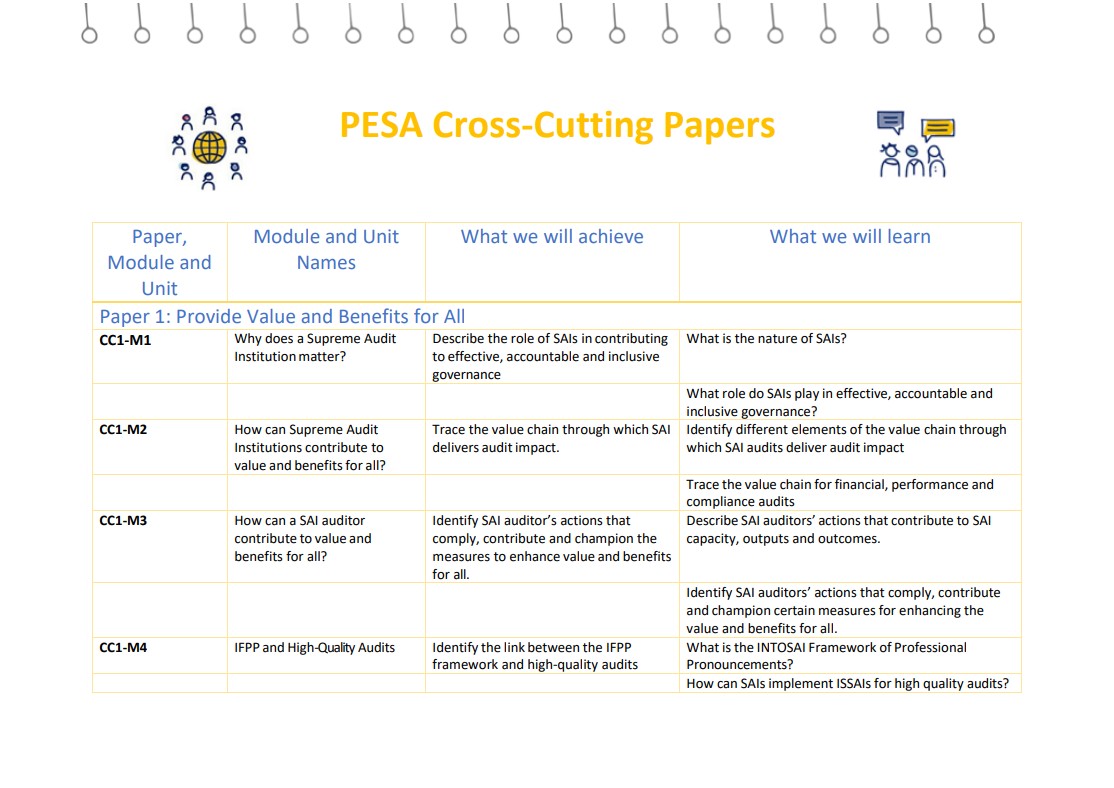
-2 bloques transversales que abarcan los resultados de aprendizaje relacionados con la reflexión acerca del valor y beneficios de las EFS y la demostración de un comportamiento profesional en el contexto de una EFS.
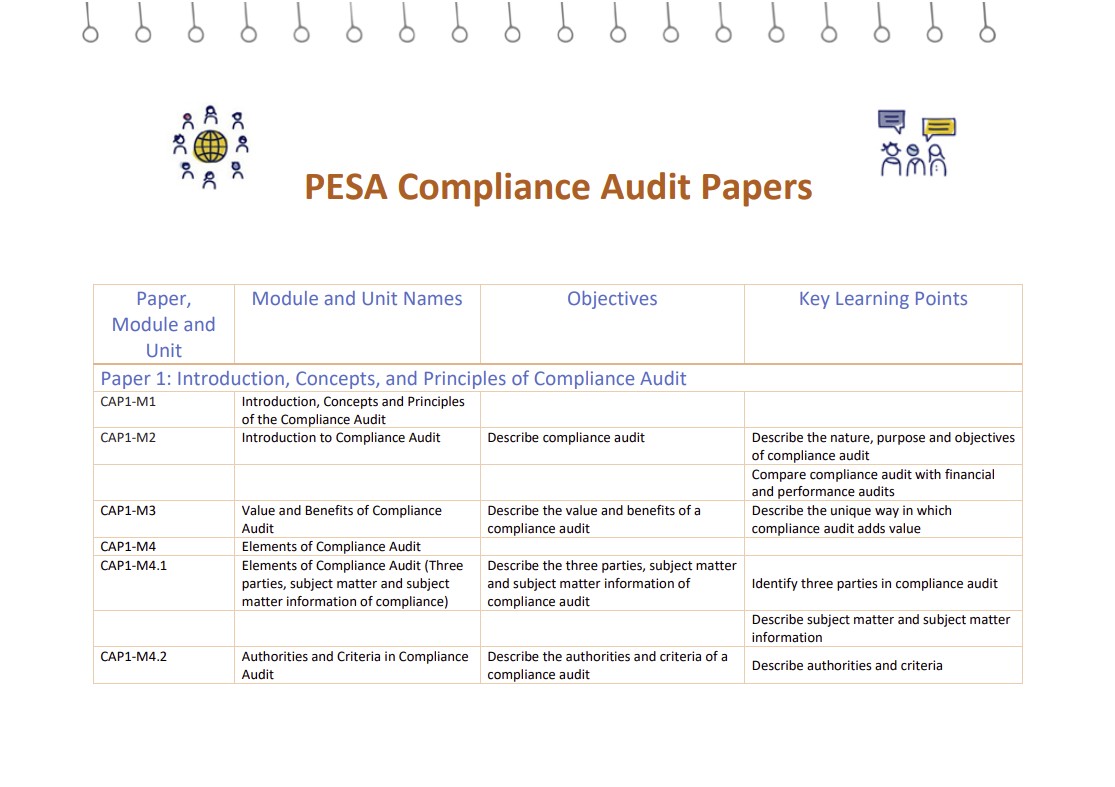
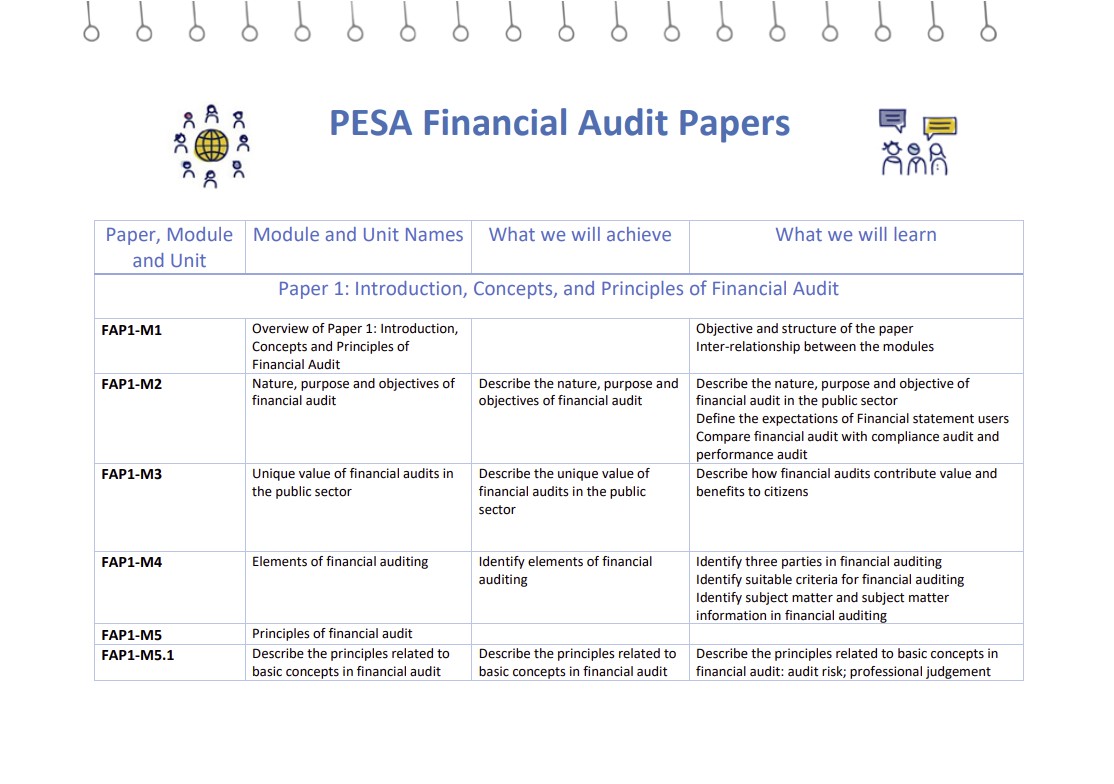
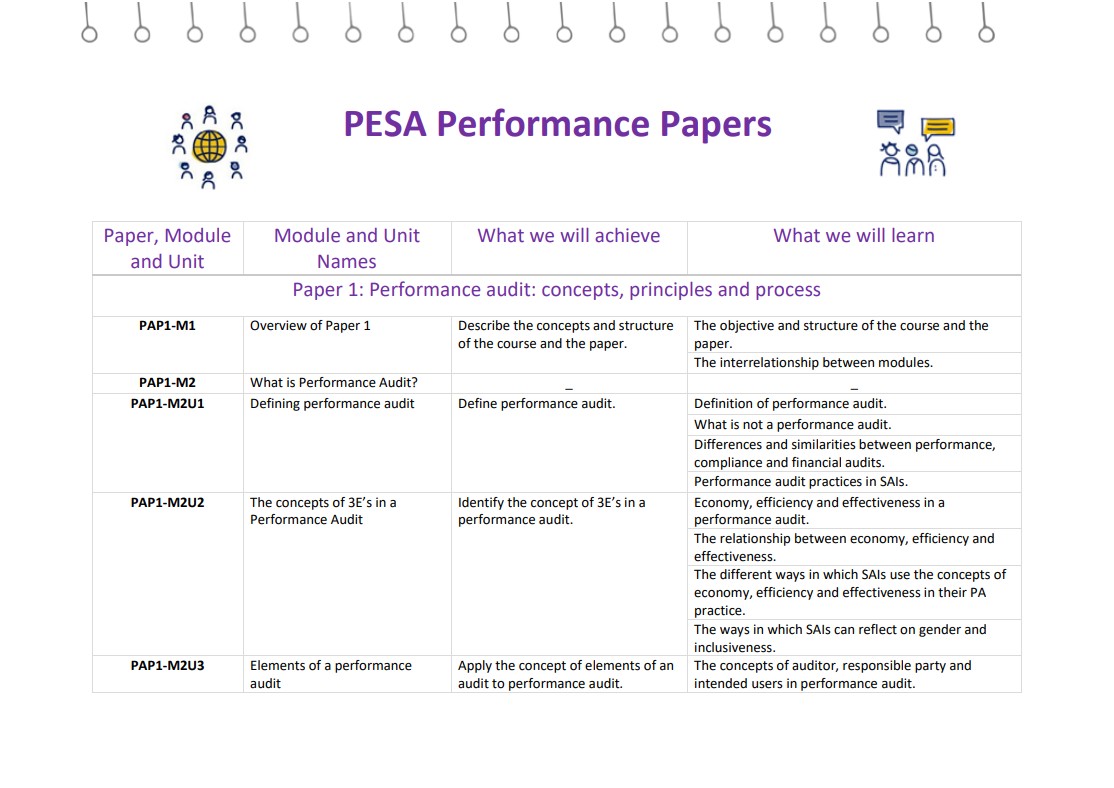
-5 bloques funcionales relacionados con el tipo de auditoría seleccionado. Los resultados de aprendizaje incluirán una demostración de habilidades y conocimientos profundos para llevar a cabo auditorías de alta calidad en uno de los 3 tipos de auditoría (de Cumplimiento, Financiera, o de Desempeño).
“Espero que hayamos respondido muchas de sus preguntas. No obstante, si tuviese más preguntas, escríbanos a pesa-es@idi.no.”
──Mateo
Mentor de TI
Seminario de bienvenida: 27 de Junio.
9 AM – hora de ciudad de México
11 AM – hora de Asunción,
Se solicita a las EFS que presenten el Compromiso de las EFS en formato PDF (Anexo 2) y el Formulario de Nominaciones (Anexo 3) a más tardar el día 19 de agosto de 2024.
Formulario de designaciones
Consult our help desk.

If you need help, please visit our PESA Help Desk.
To provide assurance through certification of competence that the candidates have achieved the learning outcomes of PESA.
The PESA Assessment exams are based on the learning outcomes set out in the education for cross-cutting and functional audit streams. Candidates will sit two assessment exams, one for Cross-Cutting and one for either Compliance Audit, Performance Audit or Financial Audit. The learning outcomes set out what we expect SAI Auditors to demonstrate, and the assessment exam questions are designed to test those outcomes.
PESA assessments should adhere to the following 6 principles:
Fairness
The PESA assessments need to be fair to all candidates and to be perceived as such.
Validity
PESA assessment activities need to be appropriate to their purpose and designed to allow candidates to demonstrate whether they have the required knowledge, skills and attributes.
Reliability
The PESA assessment activities need to be robust in design and execution and consistently applied.
Integrity
Measures need to be taken to ensure the integrity of the PESA assessment activities.
Scalability
The PESA assessment should be sustainable for future use and scalable after the pilot.
Inclusivity
PESA assessment activities should be open and fair to all learners in SAIs where they meet the entry requirements.
The above 6 principles, together, are essential to ensure that the assessment framework for PESA is robust and is therefore seen as credible by PESA stakeholders.
Cross-cutting assessment exam
The cross-cutting assessment exam will have 35 questions each worth one mark. The pass mark will be 23 correct answers. Candidates will have 90 mins (one and a half hours) to complete the assessment exam.
The weighting for the two cross-cutting papers is shown in the summary table below.
| Paper CC | |
| 1 | 49% |
| 2 | 51% |
Detailed mapping of the digital education to the assessment exam format will be provided as a part of the preparation for the mock assessment exam.
Functional streams
Each functional stream assessment exam will have 60 questions each worth one mark. The pass mark will be 39 correct answers. Candidates will have 150 mins (two and a half hours) to complete the assessment exam.
The summary below identifies the weighting for PESA functional stream papers, highlighting which papers are significant and showing the proportion of marks allocated against each of the papers within the relevant stream.
|
Paper |
FA |
PA |
CA |
|
1 |
10% |
15% |
10% |
|
2 |
10% |
10% |
10% |
|
3 |
40% |
40% |
40% |
|
4 |
30% |
20% |
30% |
|
5 |
10% |
15% |
10% |
Detailed mapping of the digital education to the assessment exam format will be provided as a part of the preparation for the mock assessment exam.
To be eligible to take the PESA assessment exams, candidates will need to have completed:
The assessments will be held annually in May and November.
Assessment exams will take place at a Pearson VUE test centre. Candidates will be able to select a test centre when booking the assessment exam.
If you are from a country with no access to a test centre please contact IDI to make alternative arrangements.
Assessment fees are capped at $125 for 2024 and 2025. Each candidate will take 2 assessment exams ($250 in 2024 in total). Each SAI is responsible for the fees for their candidates.
Once you know you are eligible, you need to book an appointment – Because the availability of test space may be limited in some locations, candidates must pre-register for PESA assessment exams. To schedule a PESA assessment exam, log in via the IDI LMS.
Identification documents (ID) – you will need to ensure you have a suitable ID. Guidance is available here: https://home.pearsonvue.com/Policies/2/English
Check the ‘what to expect’ link (https://home.pearsonvue.com/Test-takers/Resources.aspx)
Review the education, your own notes and reflection and use the mock assessment exams that will be available to help you revise for your assessment exams
IDI will make available a detailed mapping of the digital education content to the assessment exam format and mock assessment exams. The mock assessment exams will be provided online in partnership with Pearson VUE. You will not visit a test centre but may sit the assessment exam wherever you have internet access. The mock assessment exam will give you an opportunity to become familiar with the assessment exam style, structure, content and delivery platform.
Candidates who schedule the assessment exam but are unable to sit it due to unforeseen circumstances on the day should reschedule their assessment exam within the current assessment exam period.
To reschedule the assessment exam, go to the IDI LMS and select the assessment exam you would like to reschedule or cancel from ‘Upcoming Appointments.’ You will receive an email confirming any changes to your appointment. Don’t forget to click ‘Confirm Reschedule’ on the final screen to ensure your changes have been saved.
The assessment exams will be computer marked. The score is determined by the number of correct answers selected during the assessment exams. The score is represented as a percentage of the available marks in each paper, with a 65% score being required for each paper.
The IDI will moderate the assessment exam results and review reports from assessment centres before issuing the results.
On results day, you will be able to view your individual assessment exam results by logging on to your IDI account on the LMS or through your Pearson account.
In the event you are unable to achieve 65% in each assessment exam you will be permitted to retake either one or both assessment exams in the next assessment exam period . There will be an assessment exam fee for retake candidates.
Using this framework, the SAI Auditor is expected to develop knowledge and skills related to the principles of audit and the process of conducting a high-quality audit as per the ISSAIs.
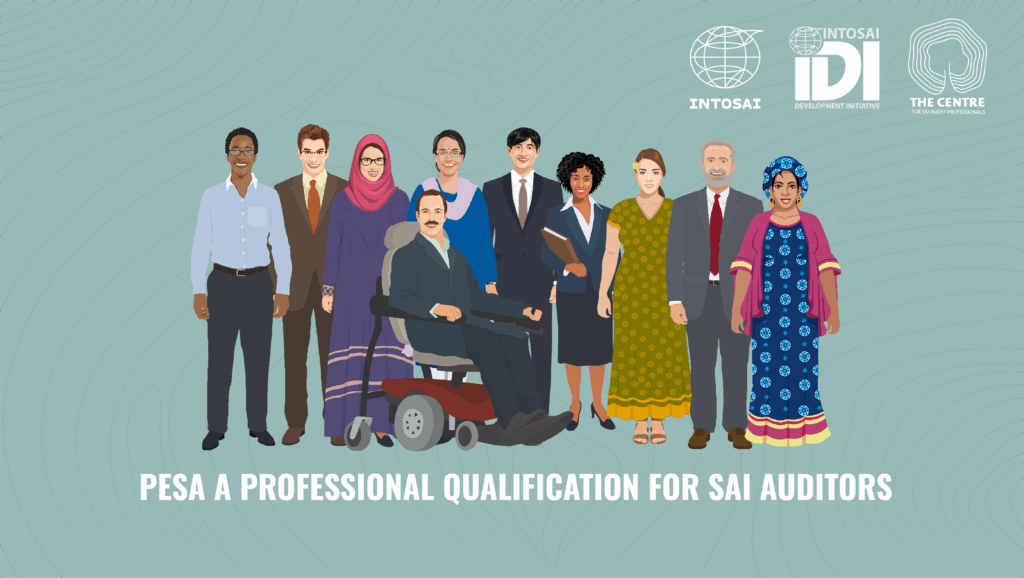
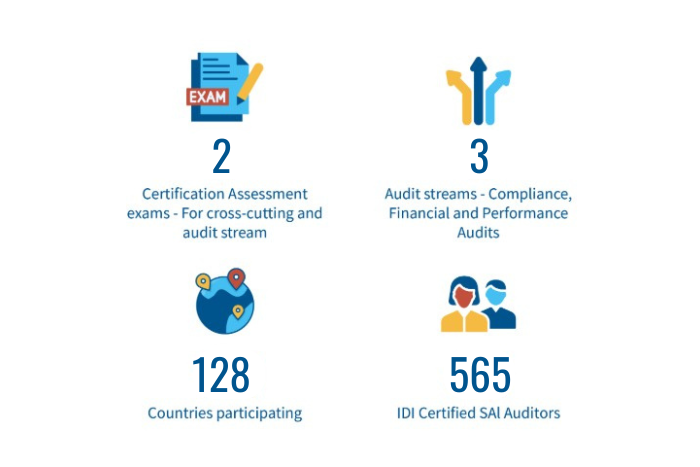
PESA is a professional education and qualification initiative that aims to create a critical mass of SAI audit professionals with competencies to add value to the SAI’s professionalisation journey. It provides opportunities for education, assessment and reflection alongside the work experience offered within a SAI. The syllabus is based on INTOSAI’s Competency Framework. The education includes two cross-cutting papers common to all participants and five papers each on compliance, financial or performance audit streams.
PESA provides education based on a syllabus designed to grow people towards the competencies outlined in INTOSAI’s Competency Framework for Public Sector Audit Professionals at Supreme Audit Institutions.
The syllabus includes outcomes related to the demonstration of knowledge, skills and personal attributes. Mapped to performance goals of a professional SAI auditor, achieving these outcomes requires you to reflect on the education and apply it in the SAI context through the initial professional development portfolio.
The Competency Framework provides for competencies that are observable and this is reflected in the learning outcomes which are designed to be measurable, and application-based. The learning outcomes will be assessed in the final competency-based assessment.
Each SAI Auditor participating in PESA will study seven papers in all. These include:
If you need help, please visit our PESA Help Desk.