IDI is working with three communities of alumni (SYL, Learning specialists and PESA) to build our network and provide Continuous Professional Development (CPD).
Specifically, we aim to:

All Learning Festival events with their respective materials can be found in Learning Festival Resources.

Watch the video prepared, produced and presented by SAI Young Leaders, for the SAI Young Leaders Learning Circle
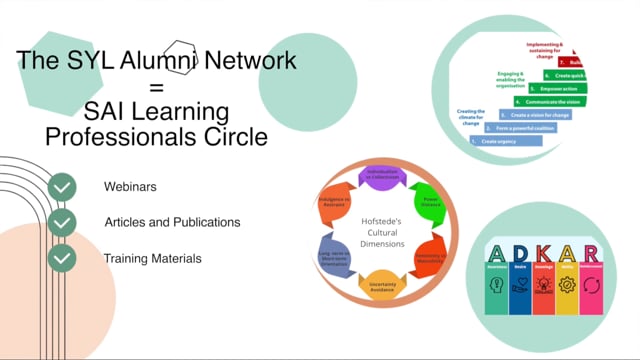
An introduction to the SAI Learning Specialists Learning circle, for IDI certified training, e-learning and blended learning specialists across the INTOSAI community.


The education in PESA is comprehensive, practical and custom-made for public sector auditors. Besides giving me confidence as a performance auditor, PESA comprehensively covered other areas of importance to SAI auditors; why Supreme Audit Institutions matter and behaving professionally. I am now well equipped to play my role in making a difference in the lives of citizens.”

PESA is a valuable tool for employee training and education and something that gives opportunity to each PA auditor within the SAI to enhance their skills at their own pace and receive IDI-issued certification upon successful completion of their education and certification.”

The IPDP was my favourite part of the program because it helped me understand a lot about my SAI, my SAI context, etc. This reflective writing is so useful and clarifying.”

PESA is not just a theoretical programme; it allows the participants to share knowledge and experiences from many different countries and reflect on what they have done while working on some issues and what they could do now that they are participating in PESA. I was very satisfied to contribute to the success of my colleagues, who have made an important effort to complete this programme.”

PESA Certification has been a transformative experience for my professional auditing career. The comprehensive training provided through the program has significantly enhanced my ability to conduct effective and impactful audits. The resources and support offered by IDI throughout the program were invaluable. I highly recommend PESA Certification to any auditor looking to elevate their expertise and contribute meaningfully to their community.”

PESA has been a transformative learning experience, equipping me with the knowledge and skills to excel as an auditor. The program not only deepened my expertise in performance auditing, but also enhanced my emotional intelligence and leadership skills, essential qualities that have greatly contributed to my professional growth. I now feel more confident in tackling new challenges and driving meaningful improvements on transparency, accountability, and, ultimately, the well-being of citizens.”

Participating in the Professional Education for SAI Auditors (PESA) of the IDI was a transformative experience for me, particularly as I began conducting financial audits within the UN Board of Auditors.
PESA significantly strengthened my technical practice, especially in the pre-engagement and planning phases, broadening my understanding of conflicts of interest, team competency matrices, and analytical procedures in the public sector context. It also reshaped my perspective on communication with management and those charged with governance, demonstrating how constructive dialogue enhances audit value. Most impactful, however, were the cross-cutting modules, which reaffirmed the auditor’s role as a driver of positive change. PESA not only refined my technical skills but also elevated my professional maturity and sense of institutional purpose.”

PESA has been a comprehensive and truly transformative learning experience for me. It combines strong technical training with the development of essential skills needed to become a better auditor. A particularly valuable aspect of PESA was the clear explanation of the purpose and importance behind audit processes and tools, which helped me moved beyond theory and apply the learning in practice. PESA is a highly valuable certification for auditors who want to strengthen their professional capabilities and contribute meaninful value to their SAIs.”

The role of Supreme Audit Institutions (SAIs) in promoting good governance, transparency, and accountability in public financial management cannot be overstated. As a certified SAI auditor, I have witnessed firsthand the impact that effective auditing can have on ensuring that public resources are utilized efficiently and effectively.
However, the ever-evolving landscape of public financial management, coupled with the increasing complexity of auditing standards and methodologies, demands that SAI auditors possess specialized skills and knowledge to remain effective. This is where the Professional Education for SAI Auditors (PESA) certification comes in.

PESA is a comprehensive certification program designed specifically for SAI auditors. The program aims to enhance the professional competence of SAI auditors, equipping them with the necessary skills, knowledge, and attitudes to perform high-quality audits that meet international standards.
The PESA certification program covers a range of topics, including auditing standards, financial reporting, risk assessment, and audit methodology. The program also emphasizes the importance of professional ethics, independence, and objectivity in auditing.
So, what makes PESA a game changer for SAIs around the world? Here are a few reasons:
PESA certification ensures that SAI auditors possess the necessary skills and knowledge to perform high-quality audits.
By equipping auditors with the latest auditing standards and methodologies, PESA certification helps to improve the overall quality of audits conducted by SAIs.
PESA certification promotes transparency and accountability in public financial management by ensuring that SAIs conduct audits that meet international standards.
PESA certification is recognized globally, providing SAI auditors with a competitive edge in the job market.
In conclusion, the PESA certification program is a game changer for SAIs around the world. By enhancing the professional competence of SAI auditors, improving audit quality, promoting transparency and accountability, and providing global recognition, PESA certification helps to ensure that SAIs remain effective in promoting good governance and public financial management.
As a certified SAI auditor, I highly recommend the PESA certification program to all SAI auditors seeking to enhance their professional competence and contribute to the global efforts to promote transparency, accountability, and good governance.
PESA aims to benefit participating SAIs, SAI auditors participating in PESA and SAI coaches supporting the participating SAI auditors.

We see SAIs as key partners in the development of professional SAI auditors. PESA can take care of a part of the education that SAIs need to provide for SAI Auditors – the core consistency framework of competence for financial, performance and compliance auditors – and the SAI needs to take care of local context.
Responsibilities:
Benefits:
We see SAIs as key partners in the development of professional SAI auditors. PESA can take care of a part of the education that SAIs need to provide for SAI auditors – the core consistency framework of competence for financial, performance and compliance auditors – and the SAI needs to take care of local context.
If you are a self- starting individual with a passion for professional education, you can apply to participate in this initiative.
Responsibilities:
Benefits:
SAI Coaches are an important part of the PESA-P education initiative. Playing the role as a conduit between the learning and the SAI environment.
Responsibilities:
Benefits:
“Let us start by watching the video to learn more about PESA, then we can take a look at the Education, Assessment and Reflection Framework (E.A.R.). Finally, we can read about both Initial and Continuing Professional Development.”

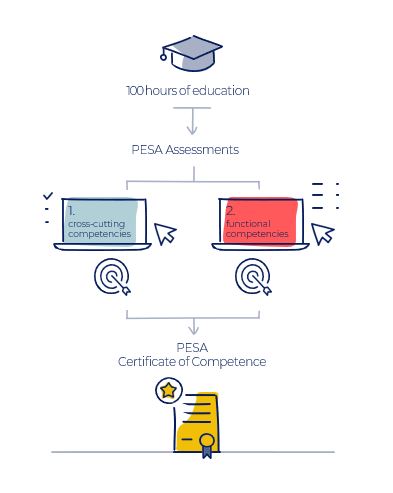
PESA emphasis robust education. It provides each participant with digitised education covering cross cutting competencies and one of the audit streams. Digitised education is supported by social learning other resources and an initial development portfolio. Each participant can access the learning materials at their own convenience.
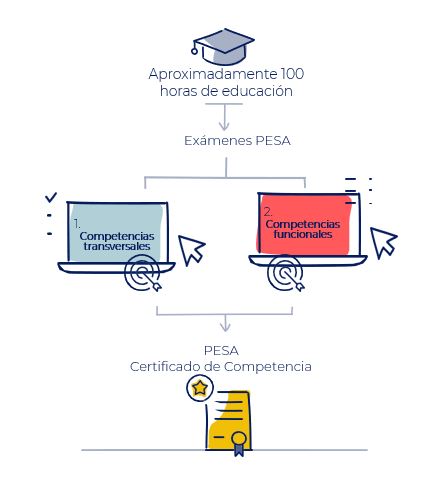
On successful completion of mandatory activities (digitised education and completion of the Initial Professional development portfolio) participants will be eligible to take two application based assessment exams. Participants who achieve the pass mark of 65% will be awarded a certificate of competence as an IDI Certified SAI Auditor.
The last and most important element of the EAR framework is reflection. The ability to exercise professional judgement is the most critical competency demonstrated by a professional auditor.
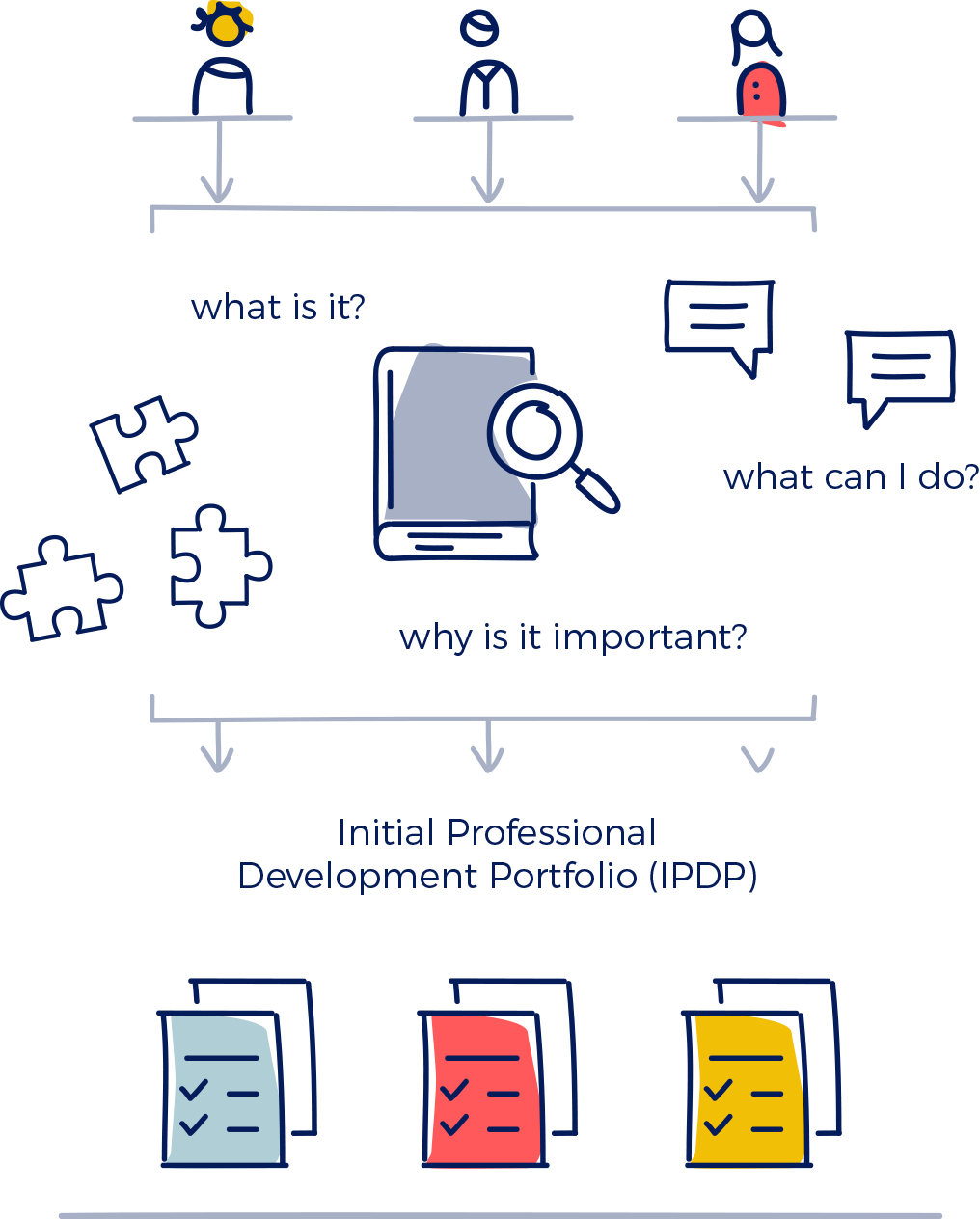
Both the PESA education and the assessments will provide opportunities for reflection to enable auditors to improve their ability to exercise professional judgement. Reflection will run throughout PESA and will encourage the learners to ask three questions about each concept:
Reflection encourages learners to link the education to individual actions within the workplace.




PESA digitised education for 17 papers has been developed using Storyline 360 and supports accessibility for SAI Auditors who are visually impaired, audio impaired or have motor disabilities. Accessibility features include keyboard navigation, visible focus indicators, voice over scripts, and compatibility with screen readers.
©All PESA-P materials are the property of IDI and should not be used without the consent of IDI.
Who is eligible to take PESA Assessments?
SAI Auditors who complete the mandatory education and IPDP will be eligible to take the PESA-P Assessments.
What will PESA Assessments look like?
PESA Assessments will consist of two computer-marked assessments. The first assessment will cover cross-cutting competencies and the second will cover functional competencies.
The assessments will be based on the learning outcomes. The questions will mainly be scenario or case based to test the SAI auditors’ ability to exercise professional judgement and apply their learning.
The pass mark for the assessment will be 65% and candidates will be allowed to resit.
The assessment will be sat either at a Pearson Vue test Centre or where this is not available at a venue outside of the SAI on the Pearson Vue ‘OnVue’ system with online proctoring, and the SAI will need to pay an examination fee that has been capped at 125 USD per exam (250 USD per participant).
PESA Certificate of Competence
Successful participants who pass both exams will be recognised as IDI Certified SAI (Compliance/Financial/Performance) Auditors.
Each participating SAI auditor will develop an Initial Professional Development Portfolio (IPDP).
The PESA is part of the ISSAI Implementation Initiative, and it is important that the education links to the workplace of the SAI Auditor. We want to develop the capability not just to talk about audit but to do an audit. Professional experience is required to ensure that auditors have the skills required by the SAI as well as the knowledge assessed in the exams.
The IPDP will guide the SAI Auditor through reflections to assist the learner in linking the education to their environment. They will reflect on how the learning applies in the SAI context and the requirements of professional audit practice in the context of the SAI.
These reflections will link to the self-paced learning and to the assessment. There will also be the opportunity for the learner to develop skills in managing professional development and prepare a SAI Auditors Development Plan.
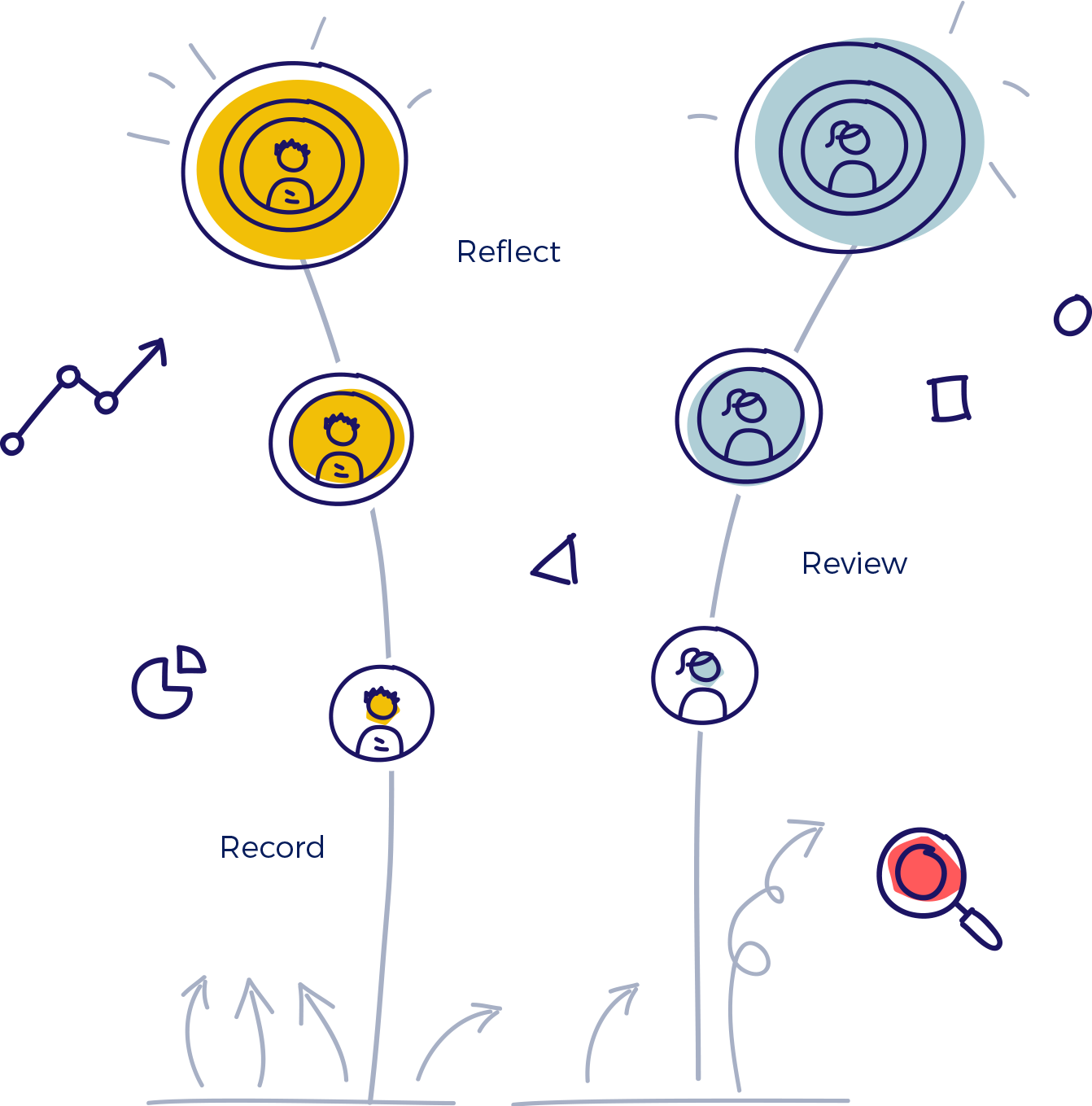
Continuing Professional Development refers to the process of tracking and documenting the skills, knowledge and experience that individuals gain both formally and informally beyond any initial training. PESA Graduates will be required to do at least 10 hours of continuing professional development per annum. It’s a record of what individuals experience, learn and then apply.
IDI encourages SAIs to put in place a system of continuing professional development of SAI Auditors certified through PESA. We also encourage SAI Auditors to proactively manage their professional development by seeking opportunities within their local context and continuing to record, review and reflect on their learning.
In line with the principle partnership for professionalisation PESA SAI Auditors will be encouraged to use the IPDP as a start of their continuing professional development (CPD).
We also offer a range of CPD events through the PESA Circle, where PESA graduates can manage their CPD compliance, access information about upcoming CPD events, connect with other PESA alumni, and contribute to lifelong learning discussions.
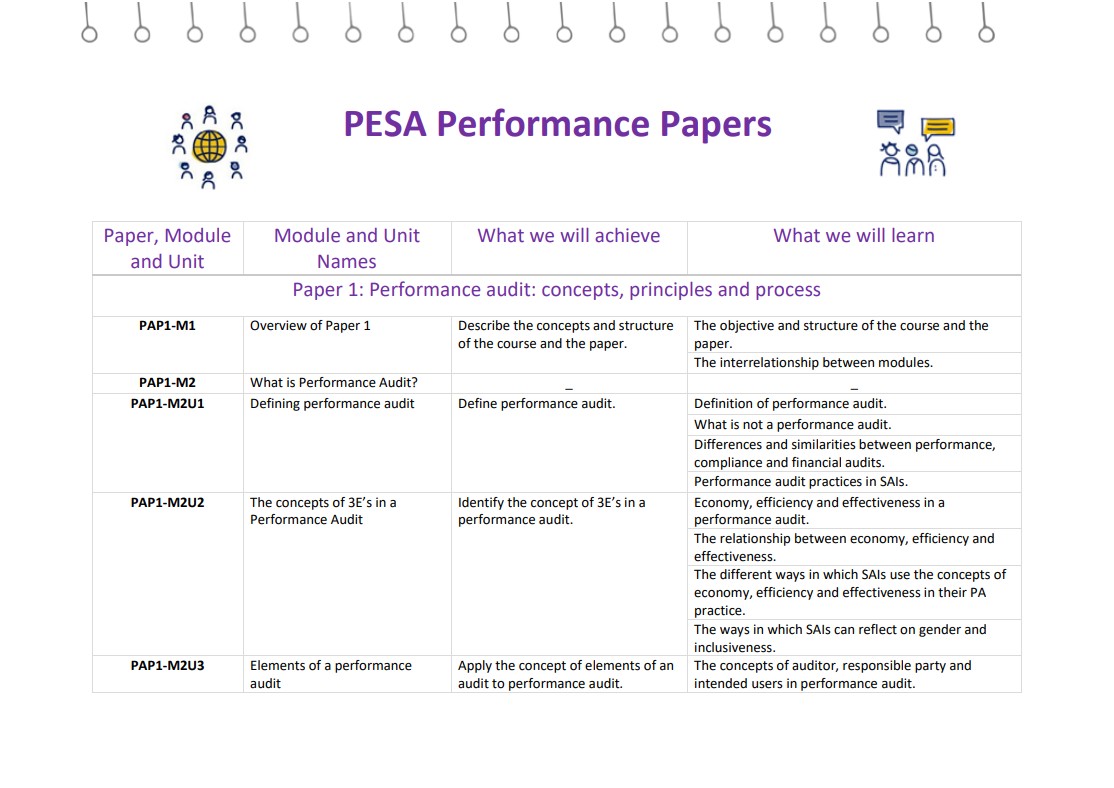
Performance audit learning outcomes start with reflections on the value and benefits of performance audit. Through the five papers, the SAI Auditor is expected to develop knowledge and skills related to, the principles of performance audit and the process of conducting a high quality performance audit as per ISSAIs.

By studying this paper the SAI Auditor will achieve the following learning outcomes:
By studying this paper the SAI Auditor will achieve the following learning outcomes:
By studying this paper the SAI Auditor will achieve the following learning outcomes:
By studying this paper the SAI Auditor will achieve the following learning outcomes:
By studying this paper the SAI Auditor will achieve the following learning outcomes:
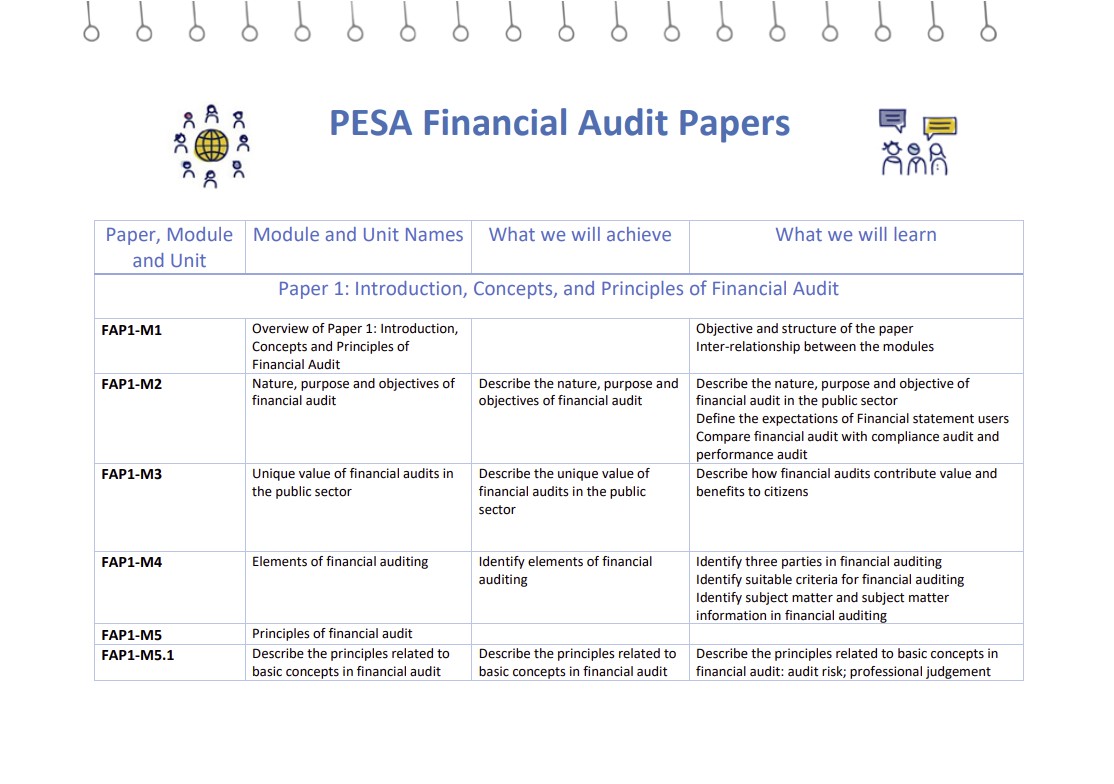
Financial audit learning outcomes start with reflections on the value and benefits of financial audit. Through the five papers, the SAI Auditor is expected to develop knowledge and skills related to, the principles of financial audit and the process of conducting a high quality financial audit as per ISSAIs.

By studying this paper, the SAI Auditor will achieve the following learning outcomes:
By studying this paper, the SAI Auditor will achieve the following learning outcomes:
By studying this paper, the SAI Auditor will achieve the following learning outcomes:
By studying this paper, the SAI Auditor will achieve the following learning outcomes:
By studying this paper, the SAI Auditor will achieve the following learning outcomes:
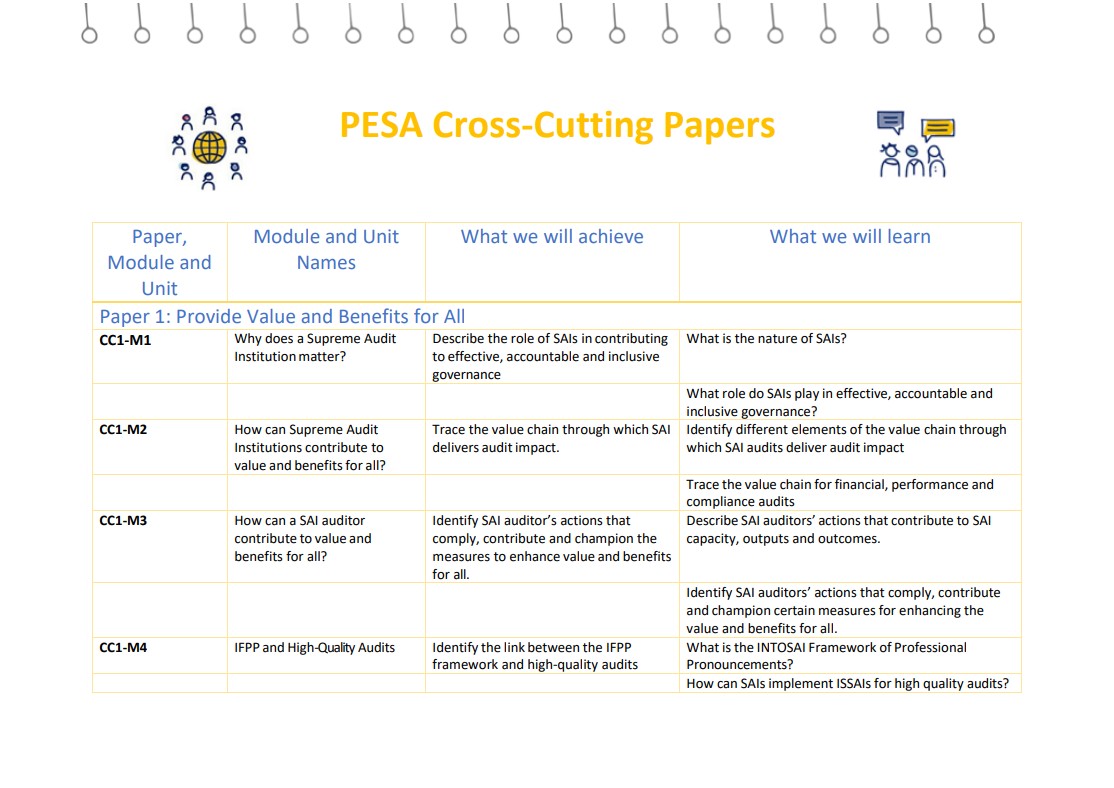
Cross-cutting learning outcomes include reflecting on value and benefits of SAIs and demonstrating professional behaviour in SAI context. These learning outcomes are relevant for all SAI auditors across the three audit streams as they form the essence of any public sector audit professional in a SAI.

By studying this paper the SAI Auditor will achieve the following learning outcomes
By studying this paper the SAI Auditor will achieve the following learning outcomes:
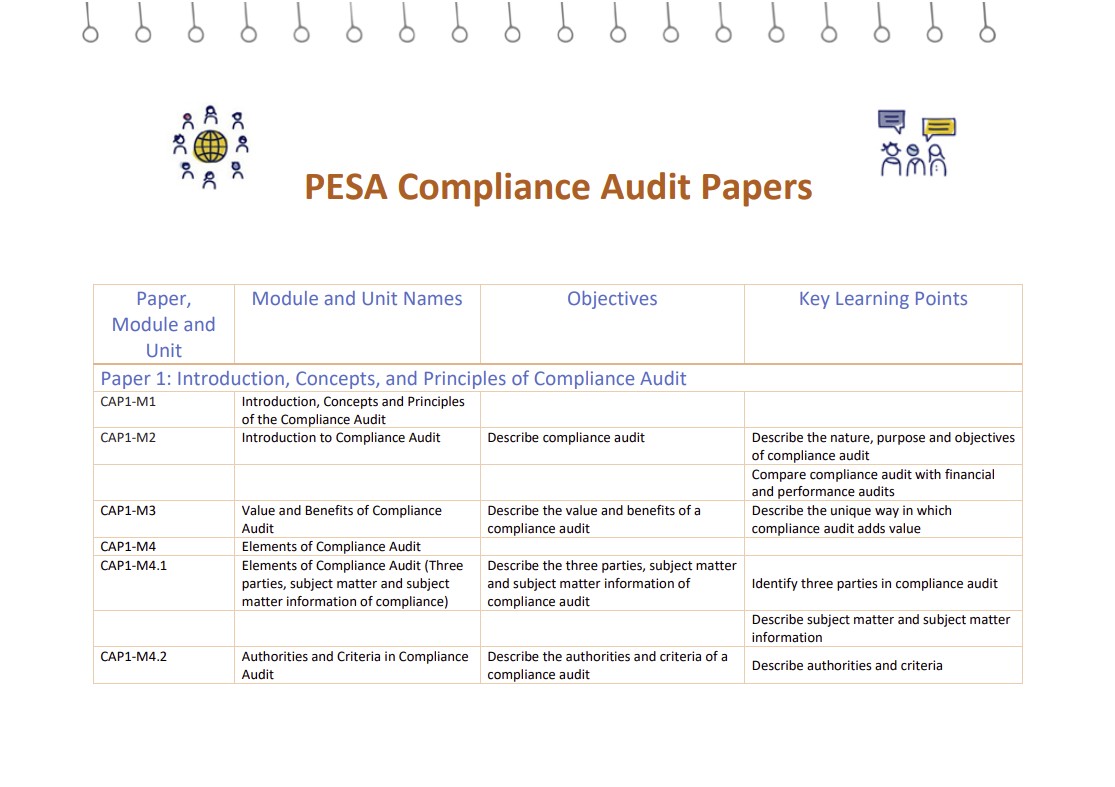
Compliance audit learning outcomes start with reflections on the value and benefits of compliance audit. Through the five papers, the SAI Auditor is expected to develop knowledge and skills related to, the principles of compliance audit and the process of conducting a high quality compliance audit as per ISSAIs.

By studying this paper, the SAI Auditor will achieve the following learning outcomes:
By studying this paper, the SAI Auditor will achieve the following learning outcomes:
By studying this paper, the SAI Auditor will achieve the following learning outcomes:
By studying this paper, the SAI Auditor will achieve the following learning outcomes:
By studying this paper, the SAI Auditor will achieve the following learning outcomes:
“Comencemos por ver el Marco de Educación, Evaluación y Reflexión (EAR, por sus siglas en inglés). Luego, leamos acerca de los Desarrollos Profesionales Inicial y Continuo.”

──Valeria
Mentora de comunicaciones
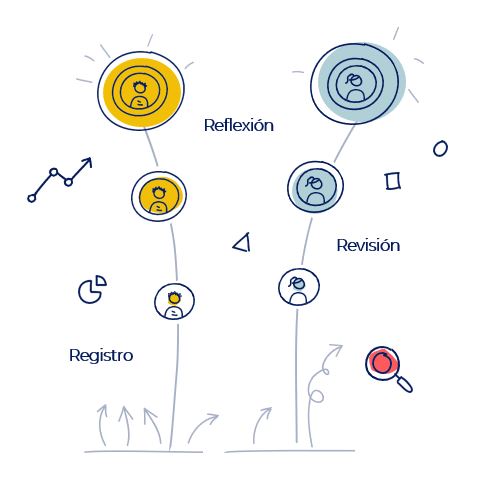
PESA se basa en el marco de Educación, Evaluación y Reflexión (EAR, por sus siglas en inglés)
PESA hace hincapié en la solidez de la formación, brindando a cada participante educación digitalizada que abarca competencias transversales y sobre el tipo de auditoría seleccionado. La educación digitalizada se sustenta en el aprendizaje social, en otros recursos, y en la elaboración de un Portafolio de Desarrollo Profesional Inicial (IPDP, por sus siglas en inglés). Cada participante puede acceder a los materiales didácticos según su conveniencia.
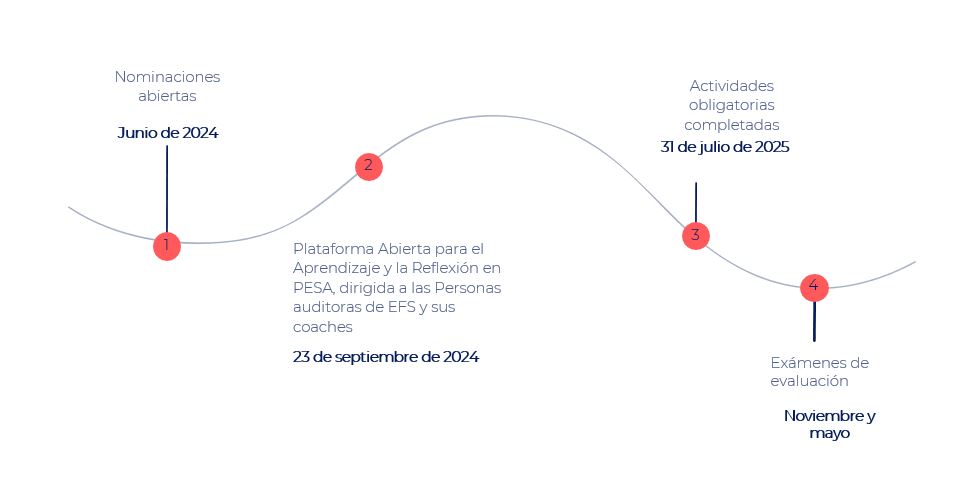
Una vez completadas las actividades obligatorias (educación digitalizada y el Portafolio de Desarrollo Profesional Inicial), las personas participantes estarán en condiciones de aplicar para dos exámenes de evaluación, uno por las competencias transversales y el otro relativo al tipo de auditoría seleccionado.
Las personas que logren superar la calificación de aprobación del 65% en ambos exámenes recibirán un certificado de competencia como Auditor o Auditora de EFS certificado/a por la IDI.
El último elemento del marco EAR, y el más relevante, es la reflexión.
La capacidad de ejercer el juicio profesional es la competencia más importante que una persona auditora puede exhibir. Tanto la educación ofrecida por PESA como las evaluaciones correspondientes ofrecen oportunidades de reflexión que permitirán a las personas auditoras mejorar su capacidad para ejercer el juicio profesional.
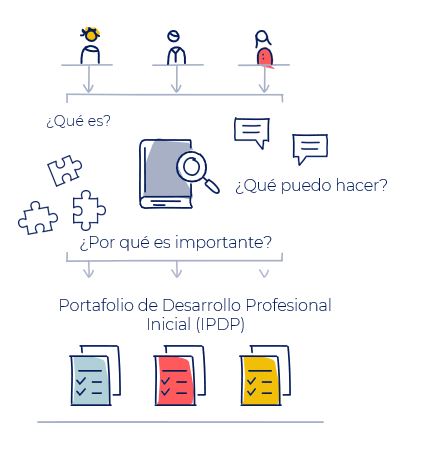
La reflexión estará presente durante toda la iniciativa PESA y alentará a los/las participantes a formular tres preguntas acerca de cada concepto:
¿Qué es?
¿Por qué es importante?
¿Qué puedo hacer?
La reflexión insta a los/as participantes a vincular la educación recibida con acciones individuales dentro del ámbito laboral.
©All PESA-P materials are the property of IDI and should not be used without the consent of IDI.
PESA se brinda mediante una plataforma integrada para educación y reflexión
Educación digital autodirigida
2 bloques sobre competencias transversales, más 5 bloques sobre Auditoría Financiera, Auditoría de Desempeño o Auditoría de Cumplimiento
La educación digitalizada brindada por PESA está integrada por 17 bloques y ofrece accesibilidad al personal auditor de las EFS con deficiencias visuales o auditivas, o con discapacidades motrices. Las prestaciones de accesibilidad incluyen navegación mediante el teclado, indicadores de foco de alta visibilidad, guiones de voz en off, y compatibilidad con lectores de pantalla..
¿Quiénes están en condiciones de acceder a una Evaluación PESA?
Se considerará que están en condiciones de acceder a una Evaluación PESA aquellas personas auditoras de EFS que completen el ciclo educativo obligatorio y el IPDP.
¿Cómo se presentan las Evaluaciones PESA?
Las Evaluaciones PESA consistirán en dos exámenes calificados de modo automático. El primer examen abarcará competencias transversales y el segundo, competencias funcionales.
Los exámenes se basarán en los resultados de aprendizaje. Las preguntas se basarán principalmente en escenarios o casos, siendo su propósito verificar la aptitud de la persona para ejercer el juicio profesional y aplicar lo aprendido.
La calificación de aprobación de la evaluación será del 65% y se permitirá a los/las participantes acceder a los exámenes por segunda vez dentro de los 12 meses de la finalización del ciclo educativo.
El primer examen abarcará competencias transversales y el segundo, competencias funcionales.
Los exámenes se administrarán a través de un centro de evaluación Pearson VUE o, cuando ello no resulte posible, tendrán lugar en una sede externa a la EFS mediante el sistema ‘OnVUE’ de Pearson VUE, con supervisión en línea.
Certificado de Competencia PESA
A los/las participantes que aprueben ambos exámenes se les reconocerá como Auditor o Auditora (de Cumplimiento/Financiera/de Desempeño) Certificado/a por la IDI.
Cada participante de PESA deberá elaborar un Portafolio de Desarrollo Profesional Inicial (IPDP), reflexionando sobre la aplicación de la educación recibida en el contexto local.
PESA forma parte de la Iniciativa de Implementación de las ISSAI y es un componente importante del Centro para Profesionales de Auditoría de las EFS.
Es importante que la educación recibida se vincule con el ámbito laboral del/la participante. Es nuestro deseo desarrollar las capacidades de modo tal que, además de poder hablar de auditoría, lo aprendido se lleve a la práctica. Se necesita experiencia profesional para asegurarse de que las personas auditoras cuenten con las habilidades que la EFS precisa, además de los conocimientos evaluados mediante los exámenes.
El IPDP orientará a la Persona auditora de la EFS mediante reflexiones que permitan a los/las participantes vincular la educación recibida con su propio entorno. Los/las participantes reflexionarán acerca del modo en que el aprendizaje se aplica en el ámbito de su EFS, y de los requisitos propios de la práctica de auditoría profesional acerca de su contexto de trabajo.
Tales reflexiones se vincularán con el aprendizaje autoguiado y con la evaluación profesional. También se dará a los/las participantes la oportunidad de desarrollar habilidades para gestionar su desarrollo profesional y elaborar un Plan de Desarrollo.
El Desarrollo Profesional Continuo (DPC) es el proceso que consiste en dar seguimiento a las habilidades, los conocimientos y la experiencia obtenidos tanto de manera formal como informal, más allá de la capacitación inicial recibida, y documentarlos. A las personas que se gradúen de PESA se les requerirá que dediquen 10 horas por año al desarrollo profesional continuo. Se trata de un registro de lo que esas personas experimentan, aprenden y luego aplican.
La IDI alienta a las EFS a articular un sistema de desarrollo profesional continuo de Personas auditoras de EFS certificadas mediante PESA. También alentamos al personal auditor a gestionar proactivamente su desarrollo profesional mediante la búsqueda de oportunidades dentro de su contexto local, y a continuar registrando, revisando y reflexionando acerca de lo aprendido.
De acuerdo con el principio de asociación para la profesionalización, se alentará al personal auditor con formación en PESA a utilizar el IPDP como el punto de partida de su desarrollo profesional continuo.
Estamos diseñando un ‘Foro de Aprendizaje’ para generar una red de ex alumnos/as certificados por la IDI, y así facilitar su desarrollo profesional continuo.

──Marta
Mentora de Auditoría Financiera
Existen tres roles principales en PESA.
El objetivo de PESA es brindar beneficios a las EFS, al personal auditor de las EFS y sus coaches mediante el apoyo a los/las participantes en la iniciativa.
Observemos esto con más detalle:
Responsabilidades:
Beneficios:
Consideramos a las EFS como socias clave en el desarrollo del personal auditor que participa de PESA. La iniciativa abarca una parte de la formación que las EFS precisan ofrecer a su personal (el marco de congruencia básica relativo a las competencias del personal auditor especializado en auditoría financiera, de desempeño y de cumplimiento), mientras que la parte correspondiente al contexto local es responsabilidad de la EFS.
Las EFS:
Responsabilidades:
Como persona auditora de la EFS participante de PESA usted:
Beneficios:
Si usted es una persona con iniciativa y pasión por la educación profesional, puede postularse para participar en esta iniciativa.
Como participante de PESA, usted tendrá una oportunidad única para:
Responsabilidades:
Las/los coaches de las EFS
Beneficios:
Las/los coaches de EFS desempeñan un rol importante en la educación de la iniciativa PESA en tanto actúan como enlace entre el proceso de aprendizaje y el entorno de la EFS.
Como coach de EFS, usted: